Why Your SaaS Pipeline Is Unpredictable (And How to Fix It)
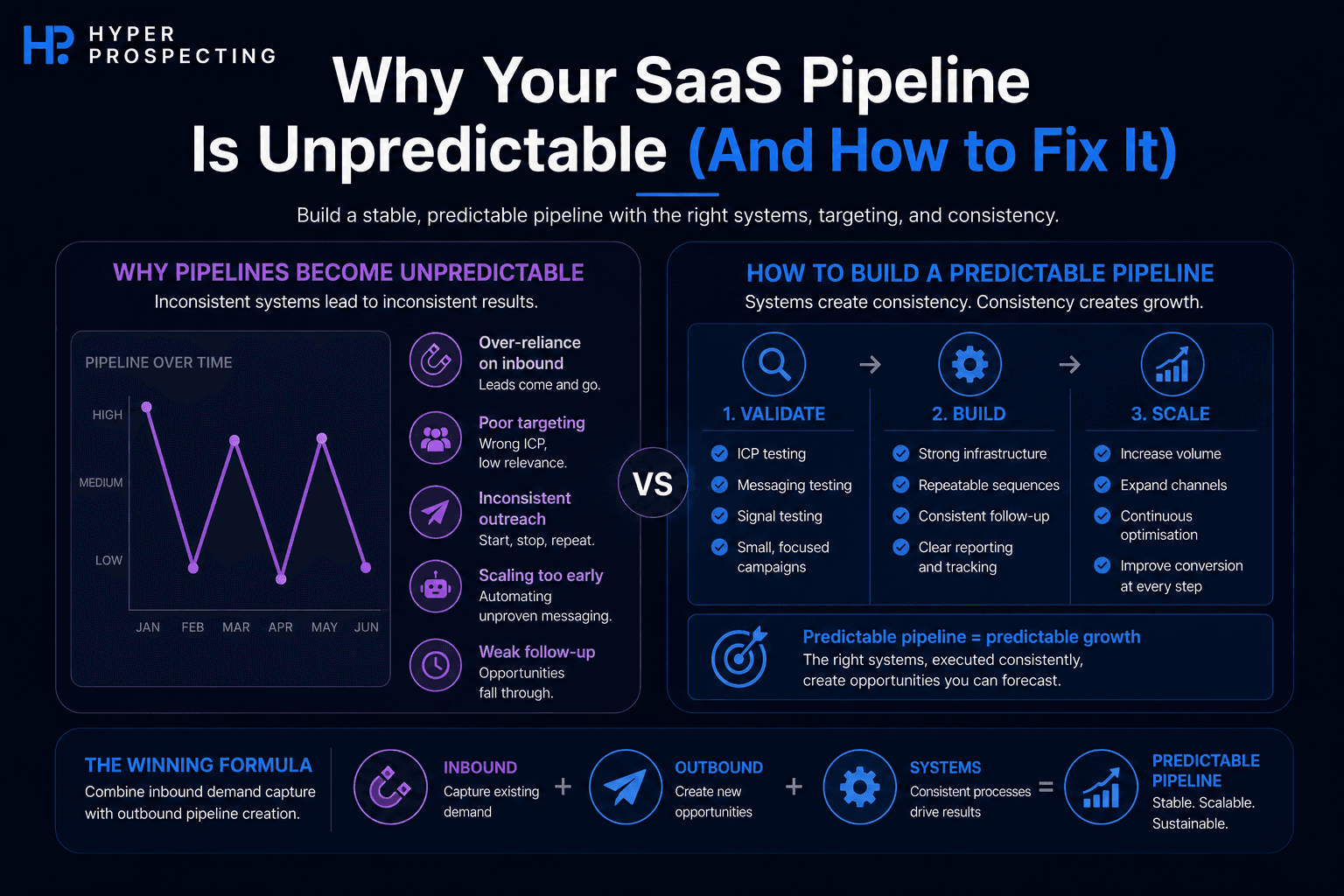
TLDR: An unpredictable SaaS pipeline almost always means the same thing: new opportunities are coming in inconsistently from month to month, and nobody can say with any confidence what next month will look like.
Most SaaS companies in this position assume the problem is demand. The market is tough, the timing is off, competition is fierce. Sometimes those things are true. But the more common reason is simpler — the lead generation process is inconsistent and difficult to repeat.
Fixing an unpredictable pipeline does not usually require a new channel or a bigger budget. It requires a more structured system.
Why SaaS Pipelines Become Unpredictable: Key Points
Over-reliance on inbound channels that fluctuate
No consistent outbound process running in the background
Poor ICP targeting that produces unqualified leads
Outreach that happens in bursts rather than continuously
Scaling volume before messaging and targeting have been validated
No structured follow-up process to move conversations forward
The most predictable SaaS pipelines are built through repeatable systems rather than relying on any single lead source.
The Real Reason Most SaaS Pipelines Become Unpredictable
When pipeline dries up, the instinct is to look outward. Blame the market. Blame the economy. Blame the fact that buyers are harder to reach than they used to be.
Sometimes those things play a role. But in most cases, an unpredictable pipeline is a system problem, not a market problem.
SaaS companies with unpredictable pipelines typically share a few common traits. Their lead generation is reactive — they ramp up outreach when pipeline looks thin and slow down when things are busy. Their lead sources are not diversified. They might rely heavily on referrals, which come in on no particular schedule, or on inbound traffic, which fluctuates based on factors largely outside their control. And their outbound activity, when it happens at all, is treated as a campaign rather than a permanent process.
The result is a pipeline that mirrors the inconsistency of the process feeding it. Good months are followed by quiet months, because the lead generation that produced the good months was not maintained consistently enough to produce the next one.
This is fixable. But fixing it means changing the process, not just increasing the activity.
Over-Reliance on Inbound Leads
Inbound can work brilliantly. Strong SEO, consistent content, and a clear brand can produce a steady flow of warm, well-qualified leads. But very few SaaS companies — especially in the earlier stages — have built inbound to the point where it can be relied on as the primary pipeline source. Research from Chameleon Sales Group found that 61% of sales leaders cite pipeline quality as their biggest challenge, and most of those challenges trace back to over-dependence on channels they cannot fully control.
The specific problems with over-relying on inbound are worth naming.
SEO takes time. A new blog post does not produce leads in the first week. Building organic traffic to the point where it generates consistent, qualified pipeline takes months. Treating it as a short-term pipeline fix sets unrealistic expectations.
Referrals are unpredictable by nature. They come when they come. You cannot plan around them. A month with three referrals and a month with none can both happen — and neither is within your control. Referrals are valuable but they are not a pipeline strategy.
Paid acquisition is expensive and hard to scale efficiently. The economics of paid lead generation in SaaS can work, but cost-per-lead tends to rise as you scale, and performance can shift quickly when ad costs move or platform algorithms change.
Inbound captures existing demand. It reaches people who are already looking. But if your buyers are not actively searching for what you offer — if they do not yet know they have the problem your product solves — inbound alone will not find them. Outbound is the only way to create that demand proactively.
Why Most SaaS Outbound Efforts Fail
Outbound is the lever most SaaS companies reach for when pipeline looks thin. They build a list, write some emails, launch a campaign, and wait. When the results disappoint, they tweak the subject line or try a different call to action. When that does not work, they question whether outbound is worth doing at all. CanadianSME’s 2026 analysis of SaaS pipeline generation puts it clearly: volume does not fix a targeting problem. It amplifies it. The companies building predictable pipelines have made a shift — instead of starting with who to contact, they start with when to contact them and why that moment matters.
The reasons outbound fails are consistent across most SaaS companies.
Random prospecting. The list is built on broad filters — a job title, a company size, a location. There is no logic for why these specific people are being contacted right now, beyond the fact that they fit a loose description.
Generic messaging. The email talks about the product, not the problem. It could have been sent by anyone, to anyone. There is nothing in it that makes the recipient think it was written with them specifically in mind.
Over-automation. The sequence runs on a fixed schedule regardless of what is happening in the conversation. There is no human judgement applied to when to follow up, when to change the angle, or when to stop.
No testing process. The campaign launches and runs without any structured approach to learning from it. What is working and what is not stays unclear, so nothing improves.
The Importance of ICP Precision
Most SaaS companies have an ICP. Few have a precise one.
There is a significant difference between a broad customer profile — “SME, 20–100 employees, UK-based, technology sector” — and a genuine understanding of which companies are most likely to have the problem you solve right now, and why they are in a position to act on it.
The broader your targeting, the weaker the relevance of every message you send. And weak relevance produces weak results, regardless of how good the copy is or how well the sequence is structured.
A precise ICP goes beyond firmographics. It includes the right company stage — not just size, but where they are in their growth trajectory and what pressures come with that. It includes the right buyer role, not just the job title but the specific person who feels the pain most acutely and has the motivation to solve it. It includes the pain points themselves — described in the language your best customers use, not in the language of your product documentation. And it includes buying signals: the events and indicators that suggest a company is more likely to be in a position to engage right now than at a random moment.
This level of targeting takes work upfront. But it is the single biggest driver of outbound performance, and almost every campaign that underperforms has a targeting problem at the root.
Why Consistency Matters More Than Intensity
One of the clearest patterns in pipeline data is that the companies with the most predictable revenue are not the ones generating the most pipeline. They are the ones generating the most consistent pipeline. PunchDev’s State of B2B SaaS Sales report, drawing on data from over 500 companies, found that traditional outbound creates a feast-or-famine cycle — one month you book 25 meetings, the next you book nine. This inconsistency makes forecasting nearly impossible and creates pressure throughout the entire organisation.
This happens because outbound is treated as something you do when pipeline is low, rather than something you do continuously. When things are busy, outreach stops. When pipeline thins out again, outreach restarts from scratch. But outbound does not produce results on day one. There is a lag — between sending a message, getting a reply, having a conversation, and turning that conversation into a qualified opportunity. When you stop outreach, you stop feeding the top of the funnel, and the effect shows up weeks later when pipeline dries up.
Consistency is what prevents this cycle. An outbound system that runs at a steady pace, week in and week out, produces a steady flow of new conversations entering the pipeline. It is not the volume of outreach in any given week that determines pipeline health. It is whether outreach is happening reliably over time.
The companies that figure this out stop treating outbound as a campaign they run and start treating it as a process that runs continuously in the background — one that feeds the pipeline regardless of how busy the sales team is with existing opportunities.
Why Most SaaS Companies Scale Too Early
When outbound is not producing results, the most common response is to send more. More emails, more follow-ups, more prospects added to the list. This feels like progress. It is usually the opposite.
Scaling volume before validating the approach means scaling the problems, not the results. If the targeting is wrong, more volume reaches more of the wrong people. If the messaging is not landing, more messages means more of the same indifference. The reply rate stays roughly the same, but more budget has been spent on producing it.
The smarter path is to validate before scaling. This means running a tightly targeted, lower-volume campaign with the specific intention of learning — not of generating maximum pipeline. Which segments respond? Which messages get replies? What does a positive reply look like in practice versus in theory? Those answers inform everything that comes after. Without them, scaling is just expensive guesswork.
Most SaaS companies also make the mistake of measuring the wrong things when they do scale. Meetings booked is the metric that gets tracked. But a meeting with the wrong person is not pipeline. It is a cost. The number worth watching is qualified conversations — conversations with people who fit the ICP, have the problem, and are in a position to do something about it.
What Predictable SaaS Pipeline Generation Actually Looks Like
Predictable pipeline does not come from a single tactic or a particularly good month. It comes from a system built in phases, where each phase earns the right to the next one.
Phase 1: Validate
Start small and focused. Pick a tight segment of your ICP and reach out to them with a small number of message variants. The goal at this stage is not to generate maximum pipeline — it is to find out what is true. Which segments respond? Which messages produce signal? What does a genuine reply look like? Run this phase honestly, without inflating the volume to make the results look better than they are.
Phase 2: Build
Once there is signal, build the infrastructure around what is working. Set up proper sequencing. Establish clear qualification criteria. Put in place a reporting process that tracks the metrics that actually matter — positive reply rate, qualified conversation rate, meetings to opportunities. Document the approach so it can be repeated consistently rather than depending on whoever is running it that week.
Phase 3: Scale
With a validated approach and a built system, scaling produces proportional results. Expand into adjacent segments. Add channels where they make sense. Increase volume where the targeting is confirmed to work. CyberDB’s analysis of B2B SaaS revenue models notes that early-stage companies typically generate around 70% of pipeline from outbound, with the balance shifting toward inbound as the brand and content engine matures. The mix changes over time, but the outbound system remains the more controllable lever throughout.
The Best SaaS Pipelines Combine Inbound and Outbound
A working pipeline is not built on outbound alone, and it is not built on inbound alone. The SaaS companies with the most stable, predictable revenue generation are running both — and they understand what each one is for.
Inbound captures demand that already exists. When someone searches for a solution to the problem you solve and finds you, that is inbound doing its job. It produces warmer leads and tends to convert at a higher rate, because the prospect has already decided they need help. The limitation is that you cannot control the timing or the volume, and it takes a long time to build.
Outbound creates demand that does not yet exist. It reaches people who fit your ICP but are not actively searching, introduces the problem in terms they recognise, and starts a conversation before they have engaged with any competitor. The limitation is that it requires ongoing investment and precise targeting to work consistently.
Together, they cover each other’s gaps. Inbound handles the people who are ready to find you. Outbound handles everyone else. And a strong inbound presence — good content, a credible website, clear positioning — makes outbound more effective too. When a prospect receives a cold email and looks you up, what they find either reinforces or undermines the message. Strong inbound content does the reinforcing.
Pipeline Predictability Comes From Systems, Not Luck
Predictable pipeline is rarely achieved through isolated tactics or occasional campaigns. It comes from building a system that can be repeated, tested, and improved over time — one that does not depend on a burst of effort from the right person at the right moment to produce results. Air Marketing’s 2026 report on how leading SaaS brands build predictable pipelines frames it well: outbound is no longer a volume play. It is a precision tool for creating qualified conversations in defined markets. The companies winning with it are the ones who have built systems around that precision rather than relying on activity alone.
A system has clear inputs and measurable outputs. You know what goes in — which accounts, which messages, which channels, which sequence — and you can see what comes out at each stage of the funnel. When something is not working, you can identify where in the process the breakdown is happening and address it specifically. When something is working, you can do more of it with confidence.
Luck produces the occasional good month. Systems produce the consistent pipeline that good businesses are built on.
Conclusion
Most unpredictable SaaS pipelines are caused by inconsistent systems, not lack of opportunity.
The fix is not a new channel or a clever campaign. It is building a structured process — one built around a precise ICP, relevant messaging, consistent outreach, and honest measurement of what is actually working. A process that runs continuously, not just when pipeline looks thin.
Companies that make this shift stop experiencing the feast-or-famine cycle that characterises most early-stage SaaS sales. Pipeline becomes something they build, rather than something that happens to them.
Further Reading
These posts go deeper into the specific areas covered here:
How to Build a B2B Outbound System That Actually Generates Pipeline
SaaS Lead Generation Agency Pricing: What It Actually Costs (2026)
FAQ
Why is my SaaS pipeline inconsistent?
The most common cause is a lack of structured outbound running consistently in the background. Most SaaS companies generate pipeline in bursts — heavy activity when things are quiet, followed by a slowdown when the team gets busy. That stop-start pattern creates the feast-or-famine cycle. The fix is a process that runs at a steady pace regardless of how busy the rest of the business is.
How do SaaS companies create predictable pipeline?
Predictable pipeline comes from building a repeatable system rather than relying on any single channel or occasional campaign. That means a clearly defined ICP, consistent outbound activity, structured follow-up, and measurement of the right metrics — qualified conversations and pipeline contribution, rather than just reply rates and meetings booked.
Is outbound still effective for SaaS companies?
Yes, but the bar for what works has risen. Generic, high-volume outreach produces diminishing returns. Outbound built on precise targeting, relevant messaging, and consistent execution continues to generate qualified pipeline reliably. The gap between campaigns that work and campaigns that do not is wider than it used to be.
Why do outbound campaigns become inconsistent?
Usually because they are treated as campaigns rather than systems. A campaign has a start date and an end date. A system runs continuously. When outreach is paused — because things get busy, because results are not immediate, because attention moves elsewhere — the pipeline effect shows up weeks later when the conversations that should have been started never were.
How long does it take to build a predictable pipeline?
Most SaaS companies see early signal within the first four to six weeks of a properly targeted outbound programme. Building a consistent, forecastable pipeline — one that you can plan around — typically takes three to six months of sustained activity. The companies that get there faster are usually the ones who validated their ICP and messaging before scaling, rather than trying to find what works at volume.
About the Author
Written by Leigh Hankin, Founder of HyperProspecting
Specialising in outbound lead generation systems for B2B companies.