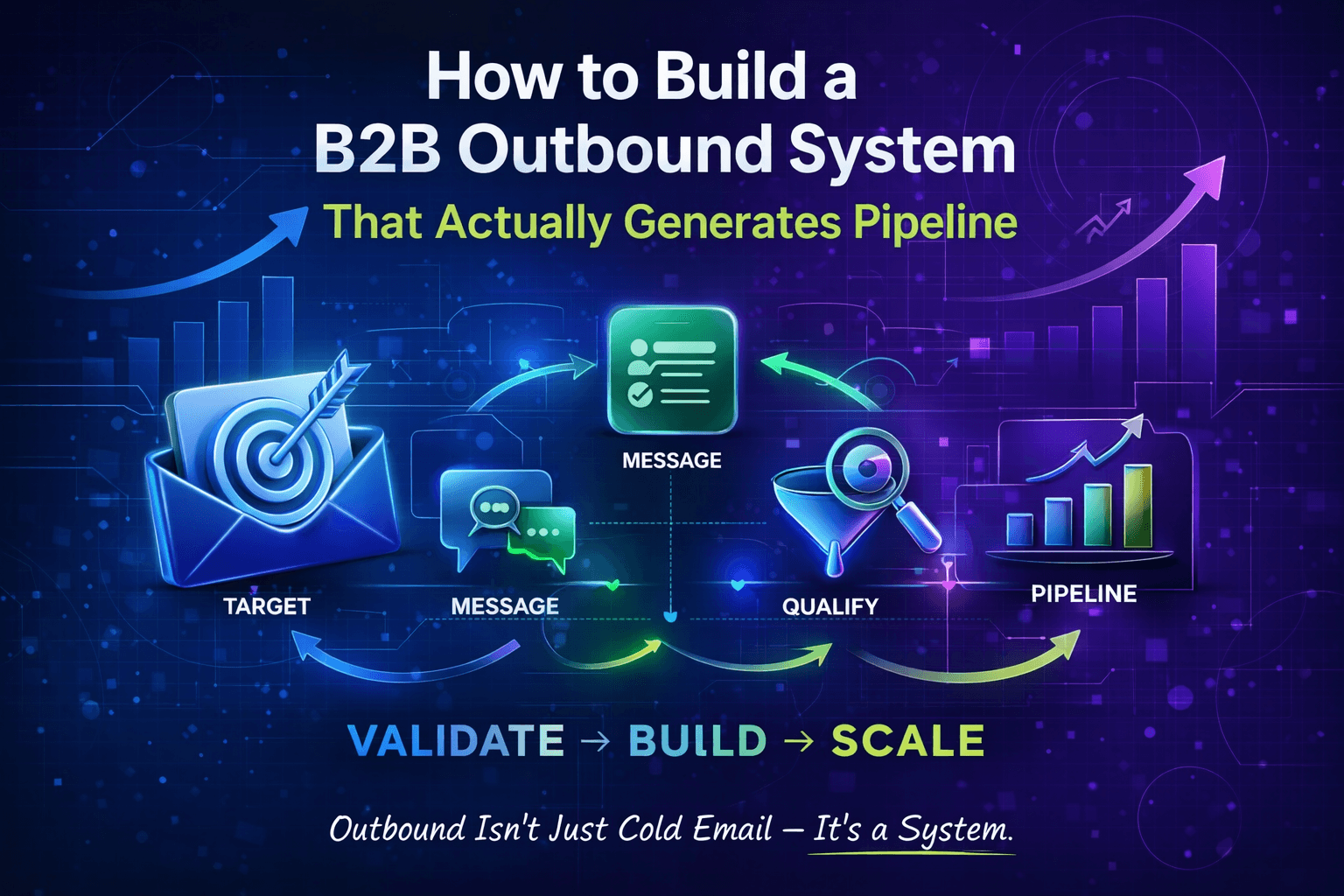
How to Build a B2B Outbound System That Actually Generates Pipeline
TL;DR: A B2B outbound system is a structured approach to generating sales opportunities through channels like cold email and LinkedIn. It brings together targeting, messaging, sequencing, and qualification into a repeatable process - one that produces pipeline consistently rather than in occasional bursts that you can’t explain or replicate.
That last part matters more than most people realise. A campaign is something you run. A system is something that runs. The difference between the two is the difference between unpredictable results and a pipeline you can actually plan around.
What Is a B2B Outbound System?
A repeatable process for generating sales opportunities through outbound channels
Built on four core components: targeting, messaging, sequencing, and qualification
Focused on producing pipeline consistently, not just generating activity
Why Most Outbound Doesn’t Work
Outbound is still incredibly important, according to a survey by Sopro of senior B2B decision makers, 78% of them still consider outbound as essential to their growth strategy. But the issue is the majority of outbound efforts fail for the same underlying reason: they’re treated as campaigns rather than systems. A campaign goes out, produces some replies, or doesn’t, and then the team debates what to try next. Nothing is repeatable. Nothing compounds. Every month feels like starting from scratch.
This is compounded by a tendency to blame the channel. Email isn’t working, so the team tries LinkedIn. LinkedIn feels slow, so they switch back. The problem is almost never the channel. It’s the absence of a coherent structure underneath it.
When outbound does work, it’s because someone has built a system meaning a clear view of who to target, a message that speaks to a real problem, a logical sequence across channels, and a way of filtering which replies are worth pursuing. Without those four things working together, you’re not running outbound. You’re running experiments with no framework for learning from them.
To further understand trends that will impact your outbound system in 2026 and beyond, this post by Salesintel provides a comprehensive overview.
What an Outbound System Actually Consists Of
Before getting into the steps, it’s worth being clear on what the components actually are. There are four of them, and they’re not interchangeable with each one does a specific job.
1. Targeting
Who you reach out to, and why. This means having a clearly defined ideal customer profile and using it to build lists of people who actually fit, not just people with the right job title. Good targeting is the foundation everything else is built on. Get this wrong and nothing downstream can save you.
2. Messaging
What you say, and how. Outbound messaging works when it leads with a problem the prospect recognises, describes it in their language, and makes a simple ask. It fails when it leads with your company, your product, and your features. The best messaging doesn’t feel like outreach, it feels like someone paying attention.
3. Channels and sequences
Where you reach out, and in what order. Cold email and LinkedIn are the two primary channels in most B2B outbound, and using them together, in a logical sequence, produces better results than either one alone. A sequence isn’t just a series of follow-ups. It’s a structured set of touchpoints, each adding something rather than just repeating the one before.
4. Qualification
How you filter which replies are worth pursuing. Not every response is a buying signal. A working system has a clear view of what a qualified reply looks like and a process for moving those conversations forward without wasting time on people who are never going to buy.
Step 1: Targeting the Right Accounts
Targeting is where most outbound systems break down, and it’s rarely because people haven’t heard of ideal customer profiles. It’s because ICP clarity is harder than it sounds. Listing attributes like “SME, 50–200 employees, UK-based, technology sector” is a start, but it’s not a targeting strategy. It’s a filter. Genuine ICP clarity means understanding what problem your best customers were experiencing when they first engaged with you, and why they were in a position to act on it at that moment.
That last piece, why they were in a position to act, is what leads to signal-based targeting. Rather than reaching out to everyone who fits a firmographic profile, you identify people who fit the profile and are showing signs that the problem you solve is live for them right now. Those signs might be a hiring push in a specific function, a recent funding round, a new market entry, a leadership change, or a product launch. Trigger events are not a gimmick. They’re the difference between reaching someone at a relevant moment and reaching them at a random one.
A smaller, better-qualified list built around genuine signals will outperform a larger, broader list almost every time. The temptation to go wide is understandable, more prospects feels like more opportunity, but it dilutes targeting, weakens relevance, and produces replies that go nowhere.
Step 2: Writing Messaging That Gets Recognised
The most common mistake in cold outreach is treating the message as a vehicle for information about your company. It isn’t. It’s a conversation opener, and a conversation opener works when it makes the other person feel understood, not when it impresses them with your credentials.
There are a few principles that consistently separate messaging that works from messaging that doesn’t.
Lead with the problem, not the product. A prospect who reads your first line and thinks “that’s exactly what we’re dealing with” is already more engaged than one who reads your company name and thinks “who?”. Problem recognition is the fastest route to a reply.
Clarity over cleverness. Outreach that tries to be witty or memorable often ends up being vague. The message that performs best is usually the one that says, in plain language, who it’s for, what problem it addresses, and what the ask is. No preamble, no padding.
One ask, not three. Most cold emails fail at the call to action. Asking someone to book a call, check out a video, and visit your website in the same message is asking too much. Pick one next step and make it easy to say yes to.
Keep it short. There’s a direct relationship between email length and reply rate, and it doesn’t run in the direction most people hope. Shorter messages, written for a specific person about a specific problem, consistently outperform longer ones.
Step 3: Building Multi-Channel Sequences
A sequence is not just a string of follow-ups to your first email. It’s a structured approach to reaching the same prospect across multiple touchpoints and, in most cases, multiple channels. The logic behind it is straightforward: people are busy, they miss things, and the best moment to reach someone is rarely the first moment you try.
Cold email and LinkedIn are the two channels that work best together in B2B outbound. Email offers scale and directness. LinkedIn offers context and warmth — a prospect who has seen your profile and accepted a connection is a warmer conversation than a cold inbox. Using both means you’re present across the channels your prospect actually uses, rather than betting everything on one.
A basic multi-channel sequence might look something like this: an initial cold email, a LinkedIn connection request a day or two later with no pitch attached, a follow-up email a few days after that with a single new point of relevance, a LinkedIn message if the connection was accepted, and a final email that makes a clear close. Each touchpoint should add something, a different angle, a piece of context, a new reason to respond, rather than simply repeating the message from the one before.
The number of touchpoints is less important than the logic behind each one. A five-step sequence where every step earns its place will outperform a ten-step sequence that’s padding the same message repeatedly.
Step 4: Capturing and Qualifying Intent
Replies are signals, not confirmations. When someone responds to outreach, it means something, but it doesn’t always mean what you hope. A working outbound system has a clear view of which replies indicate genuine interest and which are noise. It's important to understand the kinds of pipeline stages you're likely to experience when dealing with outbound leads and prioritising accordingly.
Positive intent signals tend to be specific. The prospect asks a particular question, references their own situation, pushes back on something specific in your message, or asks about timing and next steps. These replies warrant immediate, focused follow-up.
Neutral or ambiguous replies such as “interesting, tell me more” with no other context, or “we might be open to this at some point”, are worth pursuing carefully but shouldn’t be treated as qualified conversations. They need a question that tests intent rather than a pitch that assumes it.
The discipline here is in filtering rather than forcing. Not every reply can be turned into a conversation, and not every conversation can be turned into a meeting. A system that tries to force progression with every response produces a lot of wasted effort and a CRM full of stalled opportunities. A system that qualifies well produces fewer conversations and more of the right ones.
Step 5: Turning Conversations into Pipeline
Getting a reply is not the goal. Getting a qualified conversation is not the goal. The goal is pipeline, real opportunities that have a genuine chance of becoming revenue. Everything before this point is in service of that.
Turning conversations into pipeline requires two things: qualification and a clear handoff.
Qualification means confirming that the person you’re speaking with has the problem, the authority, the budget, and the timeline that make an opportunity real. This doesn’t need to be a formal process or a rigid checklist, but it does need to happen before a meeting is declared a qualified opportunity. The question to ask is simple: if this conversation went well, could a deal realistically close? If the answer is no, or not yet, that’s useful information too.
The handoff, whether that’s from an SDR to an account executive, or from outbound into a sales process, needs to be clean and contextual. The person picking up the conversation should know who the prospect is, what problem they’ve described, what was said in the outreach, and what the agreed next step is. A poor handoff loses deals that the outbound system earned.
Why Most Teams Get Stuck
There are three patterns that consistently hold outbound teams back, and they’re worth naming directly because they’re easy to fall into without realising.
The first is focusing on tools rather than structure. There’s a tendency to believe that the right sequencing platform, the right data provider, or the right AI writing tool will fix an underperforming outbound programme. It won’t. Tools accelerate a system that already works. They can’t build one. If the targeting is vague and the messaging is generic, better tools will just produce more of the same, faster.
The second is a lack of structure. Teams run outreach in response to pressure like a quiet pipeline, a new quarter, a request from leadership. They send emails, get some replies, follow up inconsistently, and move on to the next thing. This produces activity, not results. Activity that isn’t structured into a repeatable process doesn’t compound. Every month starts from zero.
The third is chasing tactics. Cold email subject lines, connection request templates, follow-up formulas — there’s no shortage of tactical advice online, and most of it is reasonable in isolation. The problem is that tactics applied without a strategic foundation don’t stick. A great subject line getting someone to open an email that isn’t relevant to them doesn’t produce a reply. The system has to be right before the tactics matter.
The Validate → Build → Scale Approach
One of the most common mistakes in outbound is trying to scale before validating. A team builds a full sequencing infrastructure, purchases a large contact list, sets up automations, and launches, only to find that the targeting assumptions were off, or the messaging isn’t landing, or the ICP they thought was right isn’t the one that responds. By the time this becomes clear, they’ve burned through a lot of time and budget.
The smarter approach is to validate first, then build, then scale. Here’s what that looks like in practice.
Validate
Before investing in infrastructure or volume, test your core assumptions with a small, tightly targeted outreach campaign. Who responds? What do they say? Which messages generate interest and which get ignored? This phase is about learning what’s true about your market, not proving that your approach is right. Run it manually if necessary. The goal is signal, not scale.
Build
Once you know what works, which segments respond, which messages land, which channel gets more traction for your audience, you build the infrastructure to support it. This is where sequencing tools, data sources, and process documentation come in. You’re not guessing at this point. You’re systematising something you’ve already tested and confirmed.
Scale
With a validated approach and a built system, scaling becomes straightforward. You increase volume, expand into adjacent segments, add channels, and refine based on data. Because the foundation is solid, adding volume produces proportional results rather than proportional problems.
Most teams skip the first two stages entirely and go straight to scale. That’s why most outbound programmes underperform.
What a Working Outbound System Actually Looks Like
It’s worth painting a clear picture of what this looks like in practice, because the goal can feel abstract when you’re in the middle of building towards it.
A working outbound system produces a predictable number of qualified conversations each week. Not a burst of activity followed by a quiet period, a consistent flow. The people in those conversations match your ICP. They have the problem you solve and are in a position to do something about it. The conversations themselves progress in a logical way toward a clear next step.
Pipeline built from a working system is also easier to forecast. Because you know your conversion rates at each stage, from message sent to reply, from reply to conversation, from conversation to opportunity, you can work backwards from a revenue target and understand what outbound activity needs to generate it. That kind of visibility is the practical payoff of treating outbound as a system rather than a collection of campaigns.
The other thing a working system produces is learning. Because the process is consistent, you can test things properly like a different message, a different segment, a different sequence structure, and understand the impact. Ad-hoc outbound produces anecdotes. Systematic outbound produces data you can act on.
Conclusion
Outbound works when it’s treated as a system. Not a channel, not a campaign, not a tactic, but a structured, repeatable process built on clear targeting, relevant messaging, logical sequencing, and disciplined qualification.
The teams that get this right don’t have access to better tools or more budget. They’ve done the work of validating their approach before scaling it, and they’ve built a process they can measure, learn from, and improve over time. That’s what turns outbound from something you try into something you rely on.
Further Reading
If your reply rates are lower than you’d like, or you’re getting replies but not pipeline, these posts cover the underlying issues in more detail:
You can also watch 'Generate 1000s of B2B Leads With This Outbound GTM Playbook', which covers many layers addressed in this post.
FAQ
What is a B2B outbound system?
A B2B outbound system is a structured, repeatable process for generating sales opportunities through channels like cold email and LinkedIn. It combines targeting, messaging, sequencing, and qualification into a consistent approach that produces pipeline rather than one-off results.
Does outbound still work in 2026?
Yes, but the bar has risen. Generic, high-volume outreach produces diminishing returns. Outbound that is built on precise targeting, relevant messaging, and a clear understanding of buyer intent continues to generate pipeline reliably. The teams that say outbound doesn’t work are almost always the ones running campaigns without the underlying system.
How long does it take to see results from outbound?
If targeting and messaging are properly aligned, most outbound campaigns start generating replies within the first few weeks. Building a steady flow of qualified pipeline typically takes a bit longer, often six to eight weeks for the sequencing to run its course and for enough data to identify what’s working. Teams that try to scale before validating tend to wait much longer, and often never find the answer.
What’s the difference between outbound and inbound?
Inbound is when prospects come to you, usually through content, SEO, or paid advertising. Outbound is when you go to them, through direct channels like cold email and LinkedIn. Both can generate pipeline, but outbound gives you more control over who you reach, when, and with what message, which makes it more predictable when done well.
How do you measure whether an outbound system is working?
The key metrics are positive reply rate, qualified conversation rate, meetings booked, and meetings that convert to opportunities. Raw reply rate is a useful leading indicator, but it doesn’t tell the whole story. A system that generates fewer replies but more qualified conversations is performing better than one with high reply volume and low conversion to pipeline.About the Author
Written by Leigh Hankin
Founder of HyperProspecting
Specialising in outbound lead generation systems for B2B companies.