
Why B2B Outbound Lead Generation Fails (And How to Fix What's Actually Broken)
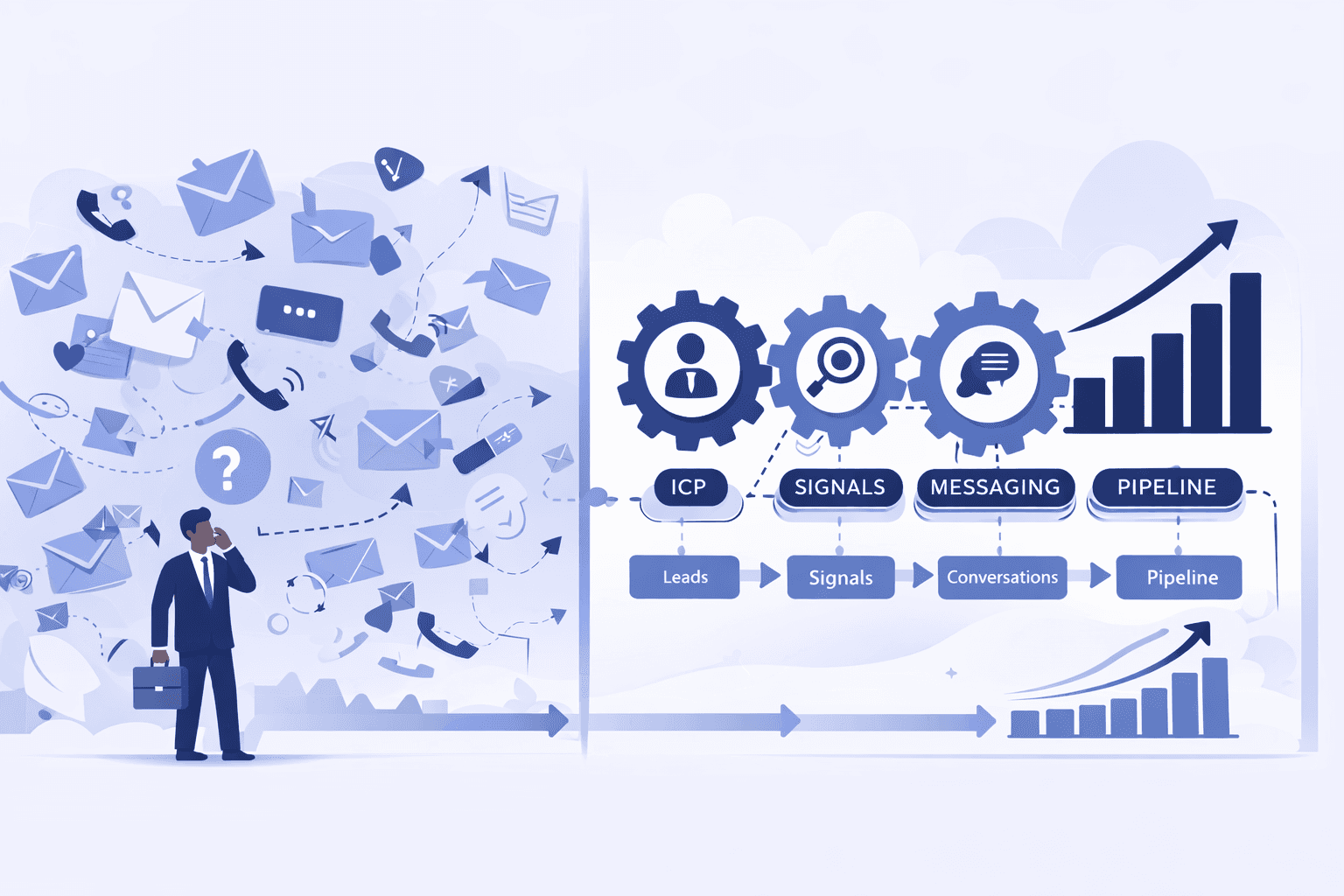
TL;DR: Outbound lead generation usually fails because the underlying system is misaligned, not because companies aren’t doing enough activity.
Most teams respond by sending more emails, booking more calls, or pushing harder on volume. Those actions rarely fix the real problem.
When targeting, messaging, and process design aren’t working together, outbound campaigns generate a lot of activity and very little pipeline. The solution isn’t to do more of the same. It’s to fix what’s actually broken.
Why Outbound Lead Generation Fails
Most outbound campaigns fail because of:
poorly defined ideal customer profiles
lack of signal-based targeting
messaging that doesn’t connect to real problems
fragmented tools and processes
no structured testing or iteration
inconsistent execution across campaigns
The Real Reason Outbound Fails
There’s a version of this conversation that happens in almost every B2B company that’s struggling with outbound. Results are poor, so the decision is made to increase activity. More emails. More calls. More sequences. More reps.
The results stay poor.
The issue isn’t the amount of activity. It’s the system behind the activity.
Outbound is a system. It has inputs like the targeting, data, messaging, infrastructure, and it has outputs such as conversations, pipeline, revenue. When the outputs are bad, the instinct is often to increase the inputs. But if the inputs themselves are the problem, more of them just produces more of the same result.
The teams that get consistent results from outbound aren’t the ones sending the most emails. They’re the ones who’ve designed a system that produces relevant conversations with people who have a genuine reason to engage.
Outbound doesn’t fail because companies aren’t doing enough. It fails because the underlying system isn’t designed to generate relevant conversations.
Poor ICP Definition
Most companies define their ideal customer profile too broadly. They pick an industry. They set a company size range. They identify a job title. And then they assume that anyone who fits those criteria is a viable prospect.
That’s not an ICP. That’s a demographic filter.
A genuine ICP is built from your best existing customers, the ones who got the most value, converted fastest, and stayed longest. It asks what those companies had in common beyond surface-level firmographics. What was happening in their business when they started looking for what you offer? What did they have in place already? What were they trying to solve?
When an ICP is defined too broadly, the prospect list gets large and the relevance gets thin. You end up contacting hundreds of companies that sort of fit your profile but have no real reason to care about the conversation right now.
In reality, only a small subset of companies in any category are actually in a position to buy at any given time. A narrower, better-defined ICP produces a smaller list, and far better results. For a deeper dive into this topic, take a look at this post by Instantly specifically for outbound teams.
No Signal-Based Targeting
This is where most outbound efforts leave the most value on the table.
Firmographic targeting includes industry, size, geography, job title, which tells you whether a company could theoretically be a fit. It tells you nothing about whether now is the right time to reach out.
Timing matters more than fit. A company that’s a perfect ICP match but has no urgency right now is a much harder conversation than a slightly-less-perfect fit that’s actively dealing with the problem you solve.
Signal-based targeting looks for indicators that a company is at a moment where the conversation would be relevant. Some signals are obvious:
a new hire in a relevant role
a recent funding round
a product launch or expansion
rapid team growth in a specific department
a job posting that reveals a current priority or pain
Others are more specific to your particular offer. The point is that signals shift your targeting from “who might care about this eventually” to “who has a reason to care about this now.”
Outbound works best when it targets companies that have a reason to act. Without signals, you’re relying on volume and luck in roughly equal measure. You can see a more detailed overview on signals based targeting here by Prospeo.
Messaging That Doesn't Connect To Real Problems
Even when targeting is solid, messaging breaks campaigns.
The most common version of this is an email or message that describes what the sender does. It leads with the company. It explains the product or service. It lists the benefits. It ends with a CTA.
The person reading it doesn’t see their problem anywhere in it. So they move on.
Outbound messaging works when it connects to something the recipient is already thinking about. Not their industry in general. Not a vague pain category. The specific situation they’re likely dealing with given what you know about them.
Generic messaging is a targeting problem as much as it is a copy problem. If you’re emailing a broad enough list that you can’t write something specific and relevant, the list is too broad.
Feature-based messaging has the same issue. A list of what your product does means nothing to someone who hasn’t decided they have a problem worth solving. Lead with the problem. Let the product be the answer to a question they’re already asking.
Most outbound messaging fails because it describes what the sender does instead of connecting to a problem the recipient is actively trying to solve. Fix that first, before changing anything else.
And if you're struggling with putting this together in your messaging, I recommend following the PAS framework, you can see that in action here at number 6 in this post by Cognism.
Fragmented Tools and Processes
A lot of outbound systems look functional from the outside but are actually a collection of disconnected pieces held together loosely.
Prospect lists are built in one tool. Emails are sent from another. Deliverability is someone’s side responsibility. Follow-up sequences live in a platform that nobody has fully configured. Reporting happens in a spreadsheet that gets updated when someone remembers.
When performance drops, nobody can pinpoint why. Is it the targeting? The messaging? The deliverability? The timing? There’s no clean way to find out because the system doesn’t have visibility across the whole process.
Fragmented outbound also tends to have fragmented ownership. Different people own different pieces with no one responsible for how they connect. Problems fall through the gaps between them.
In many companies, outbound is split across tools and people with no unified system. That makes it genuinely difficult to diagnose what’s causing poor performance, and almost impossible to fix it in any lasting way.
No Testing Framework
Most outbound teams run campaigns rather than experiments. They send a sequence, watch the numbers, draw some conclusions, and move on to the next campaign.
The problem is that without a structured approach to testing, you can’t learn anything reliable from the results.
If you change the targeting and the messaging at the same time and results improve, you don’t know which change caused it. If a campaign underperforms, you can’t tell whether it was the list, the copy, the timing, or something technical.
Small sample sizes compound this. A campaign with 50 sends can’t tell you anything statistically meaningful. Teams draw conclusions from data that doesn’t support them, make changes based on those conclusions, and then wonder why performance stays unpredictable.
Without a structured testing approach, teams can’t isolate whether targeting, messaging, or timing is causing poor results. They’re optimising based on noise.
Inconsistent Execution
Even when all the components of an outbound system are solid, inconsistent execution destroys the ability to build on what’s working.
The ICP gets redefined every couple of campaigns. The messaging framework shifts with each new person who writes a sequence. The follow-up cadence changes because someone read an article about a different approach. The criteria for what counts as a good prospect shifts depending on who’s building the list that week.
The result is that every campaign is essentially a new experiment. There’s no baseline to compare against. There’s no compounding, and no ability to take what worked last quarter and build on it this quarter.
Many outbound campaigns are treated as one-off efforts rather than parts of a repeatable system. That makes it close to impossible to build consistent pipeline, because consistent pipeline requires consistent process.
How To Fix Outbound Lead Generation
None of this is complicated in principle. Improving outbound performance usually means fixing the structure of the system, not increasing the volume of activity.
Define a precise ICP
Start with your best customers. What did they have in common? What was happening in their business before they became a customer? Use that to build a profile that’s specific enough to actually guide targeting decisions.
Use signal-based targeting
Layer signals on top of firmographic filters. Look for companies that match your ICP and show indicators of current relevance — hiring, growth, funding, tooling changes, public announcements. The goal is conversations that are timely, not just appropriate.
Align messaging with real problems
Write for the recipient’s situation, not your own. Lead with a problem they’re likely dealing with. Be specific. Keep it short. A message that lands is one where the person reading it thinks “this is relevant to me” — not “this is a well-written email.”
Build a structured outbound system
Get the components of the system working together with clear ownership. Targeting, data sourcing, copywriting, deliverability, sending infrastructure, and follow-up should all connect into a single process that someone is accountable for end to end.
Implement testing and iteration
Test one variable at a time. Give campaigns enough volume to draw meaningful conclusions. Build a simple log of what you’ve tested and what you’ve learned. Use that to make decisions rather than gut feel.
Standardise execution
Document the process. Make it repeatable. If the ICP definition, messaging framework, and list criteria change with every campaign, you’re not running a system, you’re just doing activity.
Why Most Outbound Efforts Break Over Time
There’s another failure mode worth talking about: outbound that starts well and then gradually stops working.
It’s common. A new campaign launches with fresh targeting and solid messaging. Results are decent. Then, over time, reply rates drop. Fewer conversations get started. The team tries a few tweaks but can’t recover the early performance.
The usual culprit is the absence of a feedback loop. Nobody is systematically reviewing what’s changed, what’s still working, and what needs updating. Prospect lists go stale. Messaging that was once relevant stops connecting. Deliverability drifts. The system quietly degrades while the team keeps running it as if it’s still the same campaign it was six months ago.
Outbound systems also suffer from lack of ownership over time. The person who built the system moves on. The institutional knowledge of why certain decisions were made disappears with them. Whoever inherits the system makes changes without fully understanding how the pieces connect, and things start breaking in ways that aren’t immediately obvious.
Outbound systems often start strong but degrade over time because there’s no structured process for maintaining and improving them. Building the system is only part of the work. Keeping it functional requires ongoing attention.
The Bottom Line
Outbound doesn’t fail because people don’t respond to outreach.
It fails because the outreach isn’t relevant, isn’t timely, or isn’t supported by a system that can sustain it.
Poor ICP definition, generic targeting, disconnected tools, and inconsistent execution are all fixable problems. They’re also the problems that actually matter — not the subject line, not the number of emails in the sequence, not the send time.
When the system is designed correctly, when the right people are getting relevant messages at the right moment, and the infrastructure behind it is solid then outbound becomes a predictable way to generate new conversations. Not guaranteed, but predictable.
And predictable is what pipeline actually requires.
Related Reading
If your cold email campaigns aren’t getting replies, the issue often starts at the system level. A detailed breakdown is here:
Why Cold Emails Often Get No Replies
You may also find these useful:
Cold Email vs LinkedIn Outreach: Which Actually Works?
Cold Email Response Rate Benchmarks for B2B
If you prefer video, you can watch here on why outbound lead generation fails for B2B companies walking through the three layers you need in the outbound system.
FAQ
Why does outbound lead generation fail?
Outbound usually fails because of poor targeting, weak messaging, and the absence of a structured system. Most teams respond by increasing activity, but activity alone doesn’t fix a system that isn’t working.
What is the biggest mistake in outbound?
The biggest mistake is focusing on activity instead of system design. Sending more emails, booking more calls, and running more campaigns won’t produce better results if the targeting and messaging behind them are misaligned.
Does outbound still work in 2026?
Yes. When properly structured, outbound remains one of the most reliable ways to generate B2B pipeline. The difference between outbound that works and outbound that doesn’t is almost always in the system design, not the channel itself.
About the Author
Written by Leigh Hankin
Founder of HyperProspecting
Specialising in outbound lead generation systems for B2B companies.