SaaS Lead Generation Agency Pricing: What It Actually Costs (2026)
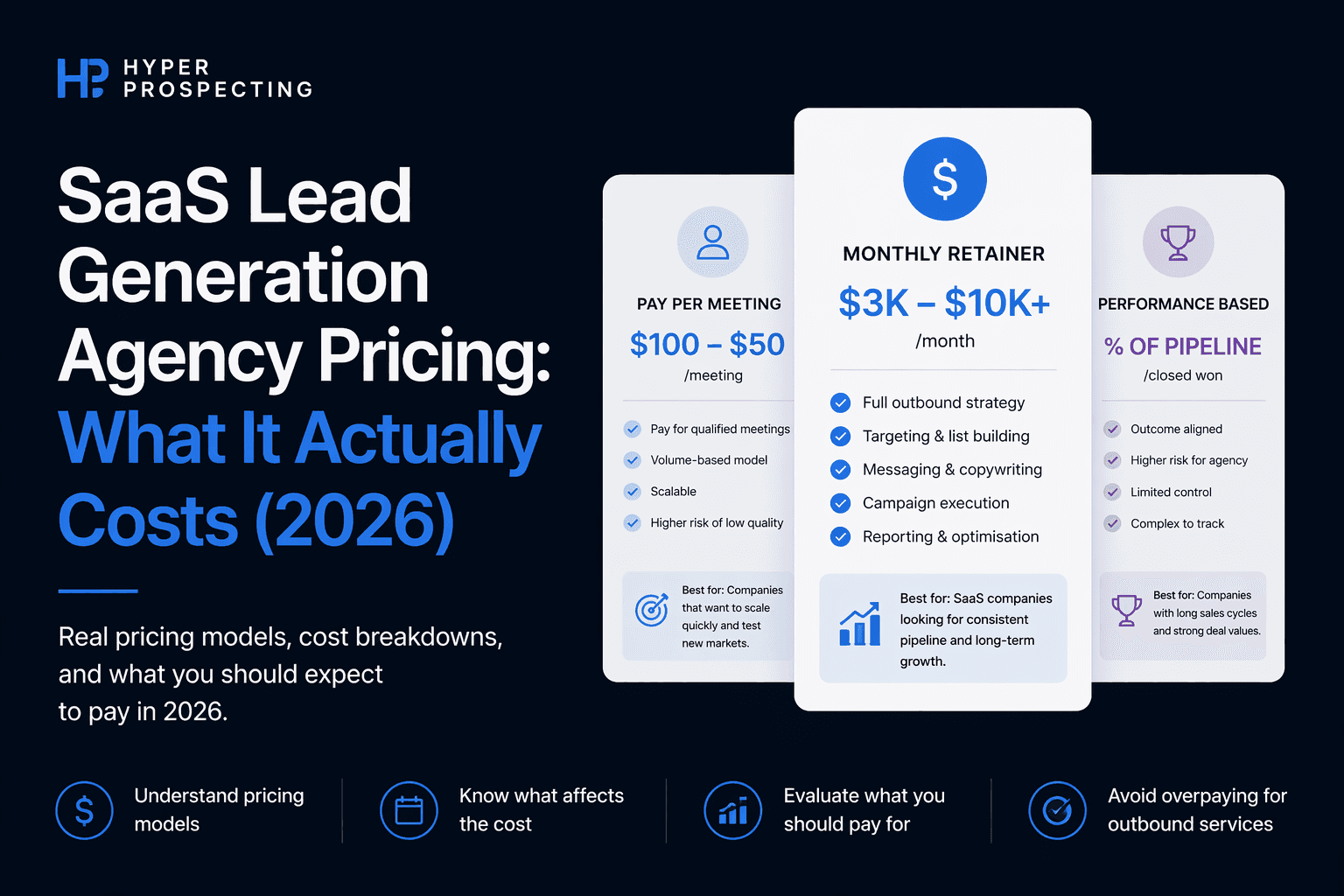
TL;DR: SaaS lead generation agency pricing varies considerably depending on the model, the scope of work, and how involved the agency is in execution. Some charge a fixed monthly retainer. Others price per meeting booked or tie fees to performance outcomes. A few use hybrid structures that combine both.
Understanding the different models is useful, but pricing alone doesn’t tell you much about whether an agency will actually deliver. The structure behind the outbound system — the targeting, the messaging, the qualification process — matters far more than the number on the invoice. That’s worth keeping in mind before you sign anything.
SaaS Lead Generation Agency Pricing: Key Points
Monthly retainers typically range from $2,000–$10,000+ depending on scope and seniority
Pay-per-meeting models often prioritise volume over quality - a distinction that matters
Performance-based pricing sounds appealing but is difficult to structure well in practice
Hybrid models that combine a base retainer with a performance element can work well when aligned with the right outcomes
The biggest issue with most agency relationships isn’t the cost - it’s misalignment of incentives
The Four Most Common Pricing Models
Most lead generation agencies for SaaS companies price their services in one of four ways. Each has its own logic, and each creates different incentives that are worth thinking through before committing. For a broader breakdown of what lead generation typically costs across channels and models, Expandi’s pricing guide offers a useful reference point.
Retainer-based pricing
You pay a fixed monthly fee in exchange for an agreed scope of work, typically covering strategy, list building, outreach execution, and reporting. Retainers range from around $2,000 per month at the entry level to $10,000 or more for full-service programmes with senior team involvement. The upside is predictability. The downside is that payment continues regardless of whether the results are there, which means the pressure on the agency to perform is lower than in other models.
Pay-per-meeting pricing
You pay a fixed fee for each meeting booked, typically somewhere between $200 and $500 per meeting depending on the market and the level of qualification involved. The appeal is obvious - you’re only paying for a tangible output. The problem is that this model creates a strong incentive for the agency to book meetings rather than qualify them. A meeting with someone who doesn’t fit your ICP costs you the same as one with your ideal customer. Volume tends to go up; pipeline quality often doesn’t.
Performance-based pricing
In theory, performance pricing aligns the agency’s incentives with your outcomes. You pay based on pipeline generated, opportunities created, or revenue influenced. In practice, it’s genuinely difficult to structure cleanly. Attribution is contested. Timelines don’t always match. And agencies offering pure performance models often cherry-pick clients with strong existing brand recognition and easy-to-convert markets, because those are the ones that make the model work for them. If a performance deal sounds too clean, it’s worth asking what assumptions it’s built on.
Hybrid pricing
A base retainer combined with a performance component - typically a fee per qualified meeting or pipeline milestone. When structured thoughtfully, this is often the most sensible model. The base covers the operational work and gives the agency a reason to invest properly in the programme. The performance element ties part of their income to outcomes and keeps incentives reasonably aligned. The key word is “qualified” - the definition of what triggers the performance payment matters enormously.
What You’re Actually Paying For (And What You’re Not)
This is where a lot of SaaS companies get caught out. Agency pricing is built around inputs — outreach volume, meetings booked, leads generated. But what you actually need is pipeline: qualified opportunities with people who have a real problem, the authority to buy, and a realistic timeline to do so. It’s worth noting that Sopro’s 2025 State of Outbound report found that 78% of senior B2B decision-makers consider outbound essential to their growth strategy, which makes the quality of that spend more consequential, not less.
Those two things are not the same, and the gap between them is where most agency relationships break down.
A campaign that books 15 meetings a month looks impressive until you realise that 12 of them are with people who don’t fit your ICP, can’t make a buying decision, or were vaguely curious rather than genuinely interested. The meeting metric goes up. The pipeline doesn’t.
The same principle applies to response rates, lead volumes, and any other activity-based metric. Activity is not the goal. Activity that converts into revenue is. The best way to evaluate an agency’s pricing is not to ask what you get for the money, it’s to ask what outcomes you can expect and how those outcomes will be measured.
Pricing tells you what the agency charges. It tells you very little about whether the system they’re building is capable of delivering what you actually need. For a more detailed look at how pipeline generation actually works in practice, Belkins’ pipeline generation guide covers the mechanics worth understanding before you hand this work to an external team.
Why Most SaaS Companies Overpay
Overpaying for lead generation rarely happens because an agency charged too much. It happens because the spend goes into a system that wasn’t ready to produce the results it was supposed to.
The most common pattern is scaling before validating. A SaaS company hires an agency, agrees a monthly retainer, and the agency launches a campaign at volume. But the targeting assumptions were never properly tested. The messaging was built on a hypothesis rather than evidence. And the ICP, while defined on paper, wasn’t refined against the reality of who actually buys and why. The result is weeks or months of spend with underwhelming returns, and a debate about whether the problem is the agency, the product, or the market.
A few specific issues come up repeatedly:
Poor targeting - reaching out to the right job titles at the wrong companies, or the right company type at the wrong stage
Weak messaging - generic outreach that doesn’t speak to a specific problem the prospect actually recognises
No validation phase - going straight to volume before confirming that the core approach produces any meaningful signal at all
Misaligned success metrics - measuring meetings booked rather than conversations that progress toward pipeline
None of these are pricing problems. But they all produce the same outcome: spend that doesn’t convert into pipeline. The agency gets paid. The SaaS company doesn’t get results. And because the root cause is structural rather than cosmetic, switching agencies without fixing the underlying issues tends to produce the same disappointment at a different price point.
What Good Pricing Looks Like in Practice
The most effective outbound programmes for SaaS companies are built in phases, and pricing should reflect that structure. Paying full retainer rates for a programme that hasn’t been validated yet is where a significant amount of unnecessary spend ends up.
A sensible approach moves through three stages:
Phase 1: Validate
Before committing to volume or a long-term contract, the priority should be testing core assumptions with a smaller, tightly targeted campaign. Does the ICP respond? Which messages produce signal? Which segments are more engaged than others? This phase is about gathering evidence, not proving a thesis. It’s typically lower-cost and shorter in duration, and it informs everything that follows. Skipping it is one of the main reasons outbound programmes underperform.
Phase 2: Build
Once there’s signal — replies from the right people, conversations that are going somewhere — you build the infrastructure to support it. This is where sequencing, tooling, and process documentation come in. You’re now systematising something that’s been tested, rather than investing in infrastructure for an approach you haven’t confirmed yet.
Phase 3: Scale
With a validated approach and a built system, scaling becomes much more predictable. You increase volume, expand into adjacent segments, and refine based on data. Because the foundation has been established, adding spend at this stage produces proportional results rather than proportional problems.
Agencies that offer this kind of phased structure are worth paying attention to. Those that skip straight to a high-volume retainer are worth approaching with caution, regardless of how compelling the pitch sounds.
Realistic Budget Expectations for SaaS Companies
Budget requirements vary significantly depending on company stage, and it’s worth being realistic about what different levels of spend can and can’t achieve.
Early-stage SaaS (roughly 5–15 people)
At this stage, the priority is signal over scale. You need to understand which segments respond, which messages land, and whether the ICP you’ve defined is the one that actually buys. A budget of £2,000–£4,000 per month can support a properly run validation and initial build phase if the targeting is tight and the programme is well-executed. What it can’t support is a high-volume, multi-channel programme. That’s not a problem — you don’t need volume at this stage. You need learning.
Founders and early sales hires often get better results running a leaner, more personal outreach programme at this stage rather than paying for a full-service agency. The hands-on involvement produces insight that agencies working at arm’s length often can’t. If you’re at this stage and want to understand what self-serve tools exist before committing to an agency, G2’s lead generation software category is a reasonable starting point for comparing options.
Growth-stage SaaS (roughly 15–50 people)
By this stage, the ICP is better understood, there’s evidence of what works, and the goal is building a more consistent and scalable outbound programme. A budget of £4,000–£8,000 per month is a reasonable range for a properly resourced agency engagement — covering strategy, execution, and meaningful reporting. Programmes at the higher end of this range should be producing a consistent flow of qualified conversations and measurable pipeline contribution. If they’re not, the issue usually isn’t the budget. It’s the structure.
How to Evaluate Whether an Agency Is Worth the Cost
The right question isn’t whether an agency is good value at their listed price. It’s whether they’re producing the outcomes that justify the investment. Third-party review platforms like Clutch can help you cross-reference agency claims against independent client feedback. Beyond that, here are the questions worth asking regularly throughout any agency relationship:
Are we reaching the right accounts? Not just accounts that fit a broad firmographic profile, but are we reaching people who are likely to have the problem we solve?
Are replies converting into real conversations? A reply rate is a leading indicator. What matters is whether those replies are from qualified prospects who progress.
Is pipeline quality improving over time? The best outbound programmes get sharper as they run. If three months in the quality of conversations isn’t improving, something in the system needs attention.
Can the agency explain what’s working and why? Reporting that only covers activity things like emails sent, open rates, meetings booked, without any analysis of what’s driving results is a warning sign.
Is the pricing model creating the right incentives? Think about what behaviour the pricing structure rewards. If it rewards volume regardless of quality, that’s what you’ll get.
Why Pricing Is Rarely the Real Problem
Most underperforming outbound programmes fail before pricing becomes relevant. The issue is usually targeting, messaging, or execution — and those are structural problems that a bigger budget doesn’t fix.
It’s worth saying plainly: a well-designed outbound system with a modest budget will consistently outperform a poorly designed one with a generous budget. The agency relationship and the price you pay for it are important, but they’re secondary to whether the underlying approach is sound.
If your current outbound isn’t producing results, the diagnostic question isn’t “are we spending enough?”. It’s “is the system we’re running capable of producing what we need?”. Those are very different questions, and they lead to very different solutions.
An agency that pushes you to increase spend before identifying why the current spend isn’t working is one worth questioning. The same goes for agencies that attribute poor results entirely to external factors such as a crowded market, a tough ICP, inbox deliverability, without taking any accountability for the quality of their targeting and messaging.
Conclusion
Pricing matters, but it isn’t the deciding factor in whether outbound works. A monthly retainer that’s been set up to validate before scaling will produce better outcomes than a larger one that goes straight to volume without testing its assumptions. A pay-per-meeting model that defines “qualified” rigorously will produce better pipeline than one that doesn’t.
The questions worth asking before signing with any SaaS lead generation agency are not primarily about cost. They’re about structure: how does the targeting work, how is the messaging developed, what does the qualification process look like, and what happens when the early results don’t match the projection?
Get those answers clearly before committing. The pricing conversation is much easier once you know the system behind it is sound.
Further Reading
If you’re evaluating outbound options more broadly, these posts cover the underlying mechanics:
Best Lead Generation Agencies For SaaS (2026) - And Which Ones Actually Work
How to Build a B2B Outbound System That Actually Generates Pipeline
FAQ
What does a SaaS lead generation agency cost?
Most SaaS lead generation agencies charge somewhere between £2,000 and £10,000 per month on a retainer basis, depending on the scope of work and level of involvement. Pay-per-meeting models typically sit between £100 and £400 per meeting. Specialist agencies with strong SaaS track records tend to sit at the higher end. Budget expectations should also account for any tool or data costs, which are sometimes included and sometimes charged separately.
Is pay-per-meeting a good model for SaaS companies?
It can work, but the definition of “meeting” matters enormously. If the agency is incentivised to book meetings without rigorous qualification, you’ll end up with a calendar full of conversations that don’t convert. The model works best when there’s a clear and agreed definition of what constitutes a qualified meeting, and when the agency has a financial stake in that qualification rather than just the volume.
What is the best pricing model for SaaS lead generation?
Hybrid models like a base retainer combined with a performance component tied to qualified outcomes, tend to produce the best alignment of incentives when structured thoughtfully. Pure retainers work when the agency is accountable and the reporting is honest. Pure performance models are difficult to execute cleanly and can create perverse incentives around which clients and markets the agency prioritises.
How do I know if an agency is worth what they’re charging?
Pricing alone won’t tell you. The more useful questions are about structure: how they approach targeting, how messaging is developed and tested, how they define and qualify a lead, and how they report on results. An agency that can answer those questions clearly and specifically is more likely to be worth the cost than one that leads with case study highlights and credential lists.
Should early-stage SaaS companies use an agency?
It depends on the stage and what the agency is being asked to do. In the very early stages, founder-led outreach often produces better learning than an agency can, because the feedback loop is tighter and the insight goes directly into product and positioning decisions. Agencies tend to add more value once there’s a reasonably clear ICP and some evidence of what kind of outreach produces signal. Using one before that point often accelerates spend without accelerating learning.
About the Author
Written by Leigh Hankin, Founder of HyperProspecting
Specialising in outbound lead generation systems for B2B companies.