How to Choose a SaaS Lead Generation Agency (Without Getting Burned)
TLDR: Choosing a SaaS lead generation agency is not just about finding someone to book meetings. It’s about finding a partner who can build you a pipeline of real, qualified opportunities — people who actually fit your product and are in a position to buy it.
Plenty of agencies can generate activity. Fewer can generate revenue. Knowing the difference before you sign a contract is what this post is about.
How to Choose a SaaS Lead Generation Agency: Key Points
Avoid agencies that promise a guaranteed number of meetings
Focus on pipeline quality, not how many emails get sent
Make sure the agency is clear on who your ideal customer is
Check that their messaging is written for cold prospects, not warm ones
Start with a validation phase before committing to a full programme
Why Most SaaS Companies Choose the Wrong Agency
Most bad agency decisions come down to the same few mistakes.
The first is not understanding outbound well enough to ask the right questions. If you’re not sure how cold email targeting works, or what a good response rate actually looks like, it’s easy to be swayed by a polished pitch and a long client list. Agencies know this. The good ones will explain their process clearly. The weaker ones will talk around it.
The second is picking based on price. The cheapest agency is rarely the best value. Lead generation done badly wastes far more than the cost of the retainer — it wastes your time, your team’s time, and months of potential pipeline. The question is not “what does it cost?” but “what will it produce?
The third is following what seems to be working for others. You read that a competitor hired a certain agency. You see case studies from companies that look like yours. But what works for one SaaS business, in one market, with one ICP, does not automatically transfer. Context matters more than reputation.
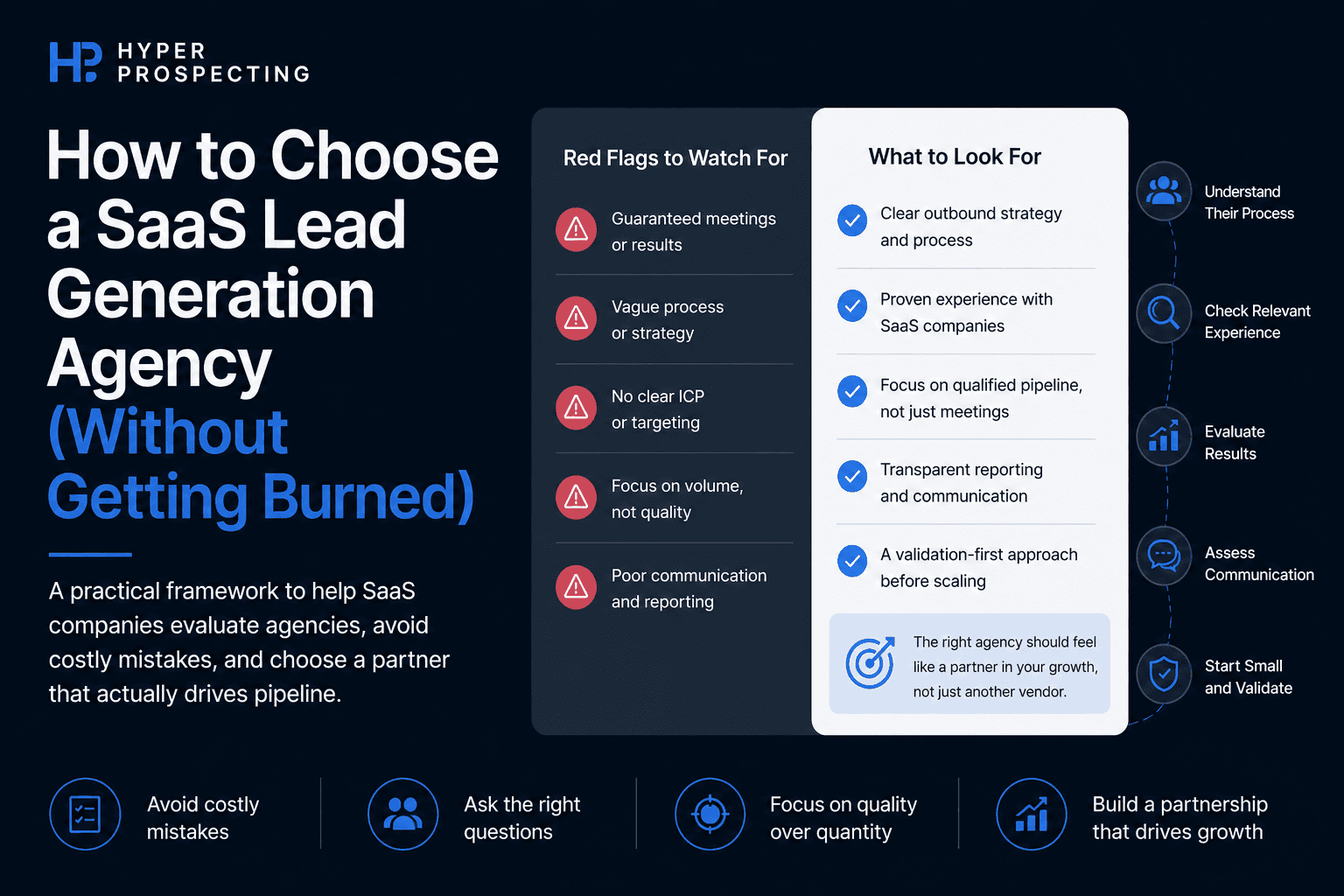
The Biggest Red Flags to Watch For
Before you get into the detail of any agency pitch, there are a few things that should make you stop and ask harder questions. B2Bmeetings’ 7-point agency evaluation framework is a useful reference here — it covers the criteria that tend to separate serious agencies from those who overpromise. The red flags that come up most often are these:
Guaranteed meeting volumes. No responsible agency should guarantee a fixed number of meetings without knowing your ICP, your market, and your offer. If they do, they’re prioritising the metric over the quality of what sits behind it.
Generic messaging. If the agency shows you outreach templates that could have been sent by any company, that’s a problem. Cold email messaging needs to speak to a specific problem a specific type of person is likely dealing with. Generic copy produces generic results.
Vague targeting. Ask how they build their contact lists. If the answer is a broad job title filter and a location, that’s not targeting — it’s a list. Real targeting involves understanding which companies are likely to have the problem you solve and why.
No testing or iteration process. Outbound requires continuous learning. If an agency launches a campaign and then waits for the contract to run its course before reviewing what’s working, you’re going to burn through budget before anyone changes anything.
Over-reliance on automation. Automation is useful for scaling something that already works. It is not a substitute for strategy, targeting, or relevant messaging. Agencies that lead with their tech stack rather than their process are often hiding a weak approach behind an impressive dashboard.
What You Should Actually Look For
The flip side of every red flag above is a green flag. Here is what good actually looks like.
A clear targeting process. The agency should be able to explain exactly how they identify the right accounts to go after. This means more than a job title filter. It means understanding what signals suggest a company might be ready to engage.
Messaging built for cold prospects. Good outbound copy is different from marketing copy. It leads with a problem, not a product. It sounds like one person talking to another, not like a campaign. Ask to see examples of messaging they’ve written for similar audiences.
A focus on qualified conversations, not meeting counts. The best agencies care whether replies are from the right people, not just whether replies are coming in. Ask them how they define a qualified conversation and how they track it.
The ability to test and adapt. A strong agency will have a clear process for reviewing what’s working, making changes based on data, and reporting on what they changed and why. This should be built into the engagement from day one, not treated as an afterthought.
Honest expectations. Good agencies give you realistic timelines and tell you what success looks like at each stage. If everything sounds like it’s going to work perfectly from the start, that’s not confidence — it’s a pitch.
Questions to Ask Before You Hire Anyone
Going into an agency conversation with the right questions is one of the best things you can do. The Lead Generation Company’s guide to questions worth asking before hiring covers this well. Here are the ones that tend to reveal the most:
How do you define a qualified opportunity? Listen for specifics. A good answer will involve ICP fit, role seniority, and some indication of interest or intent. A vague answer — “someone who’s expressed interest” — is a warning sign.
How do you build your target lists? This tells you everything about the quality of the outreach that will follow. Good targeting is built on specific criteria and refined over time. Agencies that buy generic lists and filter by job title are not targeting — they’re guessing.
What does your messaging development process look like? Ask how they go from knowing your product to writing outreach that works. Good agencies will involve you in this process. They’ll ask about your customers, their problems, and the language those customers use.
What happens if results don’t come quickly? How they answer this tells you a lot about accountability. Do they have a clear review process? Will they change the targeting or the messaging? Or will they point to external factors and wait for the contract to end?
Can I speak to a current client in a similar space? References from clients who look like you — same industry, same stage, similar ICP — are far more useful than generic testimonials. If an agency hesitates on this, take note.
For a broader list of vendor evaluation criteria, The Insight Collective’s vendor questions guide covers pricing models, contract terms, and how to assess an agency’s ability to scale alongside you.
The Right Way to Start With an Agency
One of the most common mistakes SaaS companies make is committing to a full retainer before the core assumptions have been tested.
The smarter approach is to start with a validation phase. This is a shorter, more focused period of outreach designed to test whether the targeting is right, whether the messaging lands, and whether the ICP you’ve defined is the one that actually responds.
It does not need to be long. Four to six weeks of well-targeted, properly executed outreach will tell you a great deal. You’ll know which segments respond. You’ll know which messages get replies. You’ll know what a qualified reply looks like in practice versus in theory.
Only then does it make sense to build the infrastructure and increase the volume. Agencies that push you straight to a high-volume programme without this step are prioritising their contract over your results.
A good agency will welcome a validation-first conversation. If the one you’re speaking with doesn’t, that tells you something important.
Why Most Agency Engagements Fail
Most failed agency relationships have one thing in common: outbound was treated as execution rather than a system. The agency ran campaigns. They sent emails, booked some meetings, and reported on activity. But nobody built the underlying structure that turns outbound into a reliable source of pipeline. Belkins’ pipeline generation guide is worth reading on this point — it covers how pipeline mechanics actually work and why execution without structure produces noise rather than results.
The result is a pattern that a lot of SaaS founders and sales leaders will recognise: promising early conversations that go quiet, reply rates that look reasonable but don’t convert, and a constant debate about whether the problem is the agency, the product, or the market.
Usually, it is none of those things. It is the absence of a system. No clear ICP. Messaging that was never tested properly. No process for qualifying replies. No agreed definition of what success looks like at each stage of the funnel.
An agency that approaches outbound as a system — not just as a service they deliver — is far less likely to produce this outcome. The difference shows up in how they talk about their process, how they measure results, and what they do when things are not working.
One More Thing Before You Sign
Before you commit to any agency, check their reviews on independent platforms. Clutch’s SaaS lead generation agency listings are a good starting point. You can filter by industry, company size, and budget range. More importantly, you can read what actual clients say about how the agency handled things when results were slow, not just when they were good. That’s the review that tells you what the relationship will actually feel like.
Conclusion
Choosing the right agency is not really about price or promises. It is about how they think about outbound.
Do they understand targeting? Do they write messaging that is relevant to cold prospects? Do they define qualified conversations properly? Do they have a process for testing and adapting? And are they willing to start small before pushing you to scale?
The answers to those questions will tell you more than any case study or sales deck. Ask them before you sign anything, and you will save yourself a lot of time and money.
Further Reading
If you are further along in your agency evaluation, these posts cover the details in more depth:
SaaS Lead Generation Agency Pricing: What It Actually Costs (2026)
Best B2B Lead Generation Agencies For SaaS (2026) - And Which Ones Actually Work
How to Build a B2B Outbound System That Actually Generates Pipeline
Why Outbound Lead Generation Fails (And How To Fix What’s Actually Broken)
FAQ
How do I choose a SaaS lead generation agency?
Focus on three things: how they approach targeting, how they write and test messaging, and how they define a qualified opportunity. Agencies that can answer those questions clearly and specifically are worth talking to further. Those that lead with meeting guarantees and case study highlights are worth approaching with caution.
What should I avoid when hiring a lead generation agency?
Avoid agencies that promise a fixed volume of meetings without knowing your ICP. Avoid those that send generic messaging without tailoring it to your audience. And avoid signing a long contract before you have seen any evidence that their approach actually works for your market.
How long should a trial or validation phase last?
Four to six weeks is usually enough to get a meaningful signal. You should see which segments are responding, which messages are getting replies, and whether those replies are from the right kind of people. That data is what tells you whether it makes sense to scale the programme.
What is a realistic timeline for seeing pipeline from outbound?
If targeting and messaging are properly set up, most campaigns start producing qualified conversations within the first four to eight weeks. Building a consistent pipeline — one you can forecast against — typically takes a bit longer. Agencies that promise hundreds of leads in the first few weeks are almost certainly describing low-quality contacts, not qualified opportunities.
Should I hire an agency or build an in-house outbound team?
It depends on your stage and resources. In the early stages, an agency can get things moving faster than hiring and training an SDR from scratch. As you scale and the outbound approach is proven, bringing it in-house often makes sense. The best agencies will help you build a system that could eventually be handed over, rather than creating dependency on them to keep it running.
About the Author
Written by Leigh Hankin, Founder of HyperProspecting
Specialising in outbound lead generation systems for B2B companies.