Outbound vs Inbound Lead Generation for SaaS: What Actually Works in 2026 And When To Use Each
TLDR: Outbound and inbound are the two main ways SaaS companies generate pipeline. Inbound is about pulling prospects toward you through content and search. Outbound is about going to find them directly through channels like cold email and LinkedIn.
Both can work. Neither is automatically better. What determines success is whether you are using the right approach for your situation — and whether the execution is good enough to back it up.
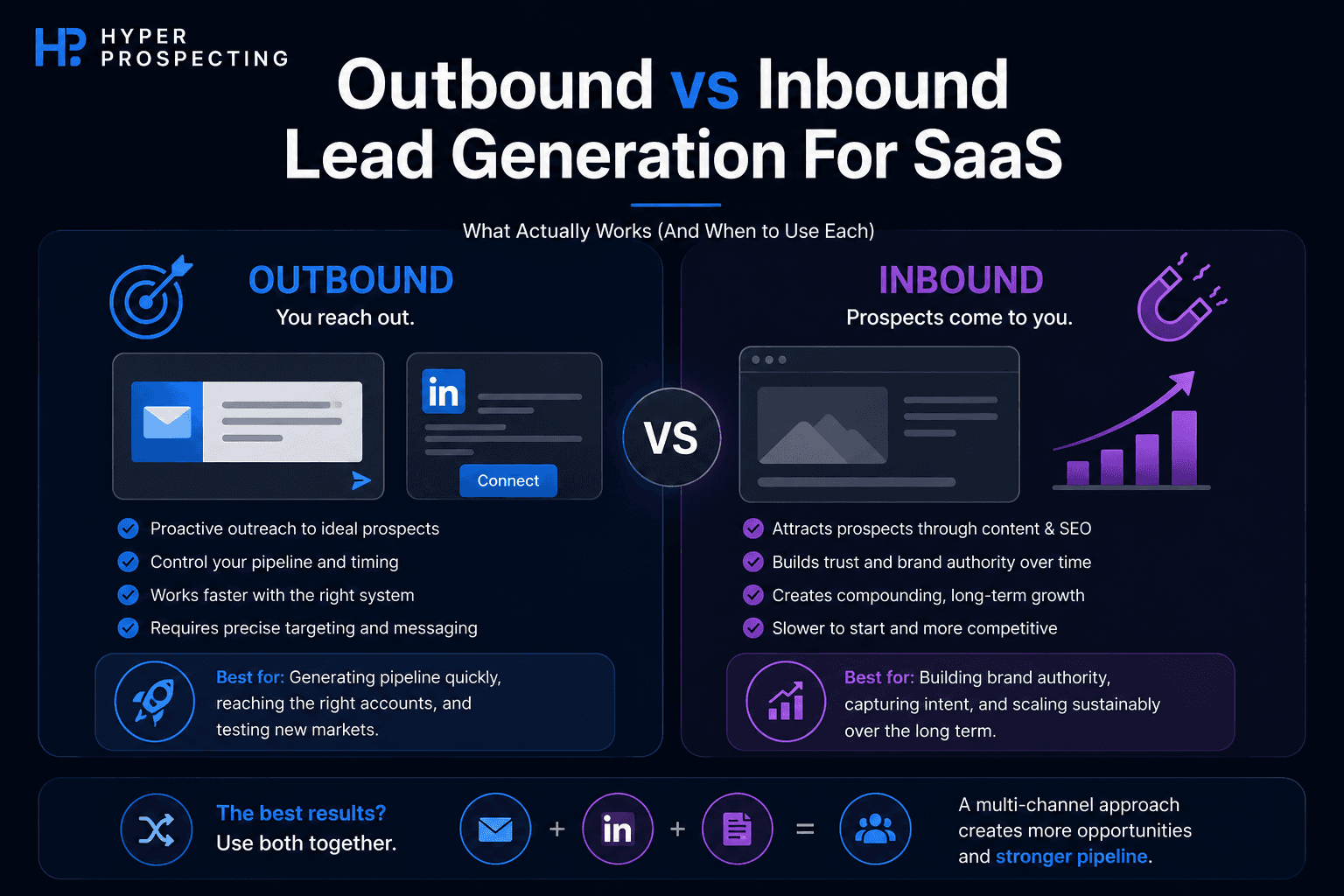
Outbound vs Inbound for SaaS: Key Points
Inbound attracts demand over time through content, SEO, and brand
Outbound creates demand directly through targeted, proactive outreach
Inbound is slower to build but compounds over time
Outbound is faster to start but needs precise targeting and strong messaging to work
The best results usually come from using both together
The Real Question: It’s Not Outbound vs Inbound
The debate between outbound and inbound is a bit of a distraction. Teams that are asking “which one is better?” are usually asking the wrong question.
The real question is: which approach fits your stage, your market, and your goals right now?
A SaaS company with a small, niche market and high deal values will get very different results from outbound than one with a broad market and a self-serve product. An early-stage team that needs pipeline fast will have different needs from a growth-stage team that is already producing inbound leads and wants to layer in proactive outreach.
Channel does not equal outcome. System equals outcome. The teams that produce consistent pipeline are the ones who have thought clearly about what their situation actually calls for — and then built a proper process around it. Those who just pick a side and hope for the best tend to get average results from both.
How Inbound Works
Inbound lead generation is built on a simple idea: create content that the people you want to reach are already looking for, and let them come to you.
In practice, this means SEO — publishing blog posts, guides, and resources that rank in search engines for terms your ideal customers are searching. It means being visible when someone types “best CRM for small teams” or “how to reduce customer churn” into Google. If your content answers those questions well, the right people find you without you having to reach out to them first.
Inbound also includes things like webinars, newsletters, gated downloads, and social content. The goal across all of it is the same: attract the right people, capture their details, and build enough trust that they are ready to talk to sales when the time comes.
The advantage of inbound is that the leads it produces are often warmer. They found you because they were looking for something. That changes the quality of the conversation. HubSpot’s State of Marketing data consistently shows that inbound leads close at higher rates than cold outbound contacts — which makes sense when you think about the intent behind them.
How Outbound Works
Outbound flips the model. Instead of waiting for the right people to find you, you go to find them.
This means identifying a specific group of companies and people who fit your ideal customer profile, then reaching out to them directly through cold email, LinkedIn, or phone. You are starting the conversation before they have expressed any interest. That is the core challenge of outbound, and also what makes it powerful when it is done well.
Done well means being specific. The outbound that works in 2026 is not the kind that blasts the same generic email to 5,000 people and hopes for a 1% reply rate. Outreachbloom’s analysis of outbound performance data shows that personalised cold emails see a 32% higher response rate than generic ones — and that the best-performing campaigns, with tight targeting and relevant messaging, regularly hit 8–10% reply rates. The volume approach still exists. It just does not work as well as it used to.
Outbound done well means reaching people who are likely to have the problem you solve, with a message that speaks directly to that problem, at a moment when they might be open to a conversation. The more precise the targeting and the more relevant the message, the better the results.
Where Inbound Breaks Down
Inbound sounds appealing. But it has real limitations that are worth being honest about.
It is slow. SEO takes time. Brand authority takes time. You are not going to launch a blog in January and see qualified pipeline in February. For most SaaS companies, inbound takes six to twelve months before it is generating meaningful lead flow. If you need pipeline now, that timeline is a problem.
It is unpredictable. Search algorithms change. A Google update can shift your traffic overnight. Organic reach on social platforms fluctuates. Inbound compounds over time, but the month-to-month results are harder to forecast than a structured outbound programme.
It is competitive. If your competitors are already producing strong inbound content, you are fighting for the same search terms and the same audience attention. Getting cut-through in a crowded market takes significant investment in content quality and consistency.
You cannot control who finds you. Inbound brings people to you, but not always the right people. You might rank well for a keyword that attracts the wrong stage of company, the wrong job title, or leads that are just doing research rather than buying.
Where Outbound Breaks Down
Outbound has its own failure modes, and they come up often enough to be worth naming.
Poor targeting. Reaching out to a broad list of people who vaguely fit a job title is not targeting. It produces low reply rates, poor quality conversations, and a team that loses faith in outbound before the real issue has been identified.
Generic messaging. Most cold outreach fails at the message. If the email could have been sent by any company, to anyone, it will be treated accordingly. Cold messaging needs to speak to a specific problem a specific person is likely dealing with. Generic copy produces generic results.
No system behind it. Outbound run as a series of ad hoc campaigns rather than a structured system produces uneven results. Without a clear process for targeting, sequencing, qualifying, and following up, the output depends entirely on who is running it and how much energy they have that week.
Treating volume as a strategy. Sending more emails is not a solution to poor performance. It is usually a way of making the problem worse faster. Volume amplifies whatever is already happening. If the targeting and messaging are weak, more volume just produces more of the same.
When Each One Works Best
Inbound tends to work best when:
You have a broad addressable market and your buyers are actively searching for solutions like yours
You are playing a long game and can invest in content consistently over months and years
Your product is relatively easy to understand and evaluate without a sales conversation
You have an existing audience or brand presence to build from
Your average deal size is lower, meaning the economics of inbound lead generation make sense
A useful way to think about this: Kondo’s inbound vs outbound decision matrix for SaaS suggests that inbound is typically most cost-effective for deals under £10,000 ACV. Once deal sizes get larger, the economics start to shift.
Outbound tends to work best when:
You are targeting a specific, defined group of companies and decision-makers
Your buyers do not actively search for your category — they need to be introduced to the problem or the solution
You need pipeline quickly and cannot wait for inbound to build momentum
Your deal sizes are large enough to justify the cost of proactive outreach
You have a clear ICP and enough market understanding to write messaging that is genuinely relevant
You are entering a new market or launching a new product and need to create awareness from scratch
Why the Best SaaS Companies Use Both
The companies that produce the most consistent pipeline are not choosing one approach over the other. They are running both. Prospeo’s analysis of B2B lead generation data shows that companies running a combined inbound and outbound approach see up to twice the revenue growth of those relying on a single channel. The logic is straightforward: inbound and outbound do different jobs, and both jobs need doing.
Inbound builds trust over time. When someone receives a cold email from you, one of the first things they do is look you up. If your website is thin, your content is weak, and there is no evidence that you know your space, that outreach lands with much less weight. Strong inbound content makes outbound more effective, even when the two are not directly connected.
Outbound accelerates pipeline. Inbound produces leads when they are ready to find you. Outbound lets you reach the right people before they start looking. For SaaS companies with a specific ICP and a defined problem they solve, that ability to be proactive is genuinely valuable — especially in the early stages when waiting for inbound to compound is not an option.
The two also work well together in more direct ways. A prospect who has downloaded one of your guides is a much warmer target for outbound follow-up. An outbound contact who engages with your emails is worth retargeting with content that builds on what they already know. Using both channels gives you more ways in and more ways to keep the conversation going.
The Real Problem Isn’t the Channel
Whether you run outbound, inbound, or both, the outcome still depends on how well the underlying system is built. A great SEO strategy with weak content will not produce pipeline. Outbound with vague targeting and generic messaging will not either. Headley Media’s guide to outbound lead generation makes this point clearly: outbound has evolved away from cold lists and volume plays toward something much more precise and intent-driven. The same shift is happening in inbound — content that used to rank easily now needs to be genuinely useful and specific to compete.
The teams that get consistent results from either channel are the ones who have done the harder work first. They know who they are targeting. They understand what problem they solve and for whom. They have tested their messaging and refined it based on what actually gets replies. And they measure the right things — qualified conversations and pipeline, not just open rates and page views.
The channel is a delivery mechanism. The system is what makes it work.
Conclusion
Outbound and inbound are not rivals. They are different tools for different jobs, and most SaaS companies need elements of both.
If you need pipeline now and you know exactly who you are targeting, outbound is the faster route. If you are building for the long term and have the patience to invest in content and SEO, inbound compounds in ways outbound cannot.
The best SaaS teams do not choose. They build both, deliberately and in parallel, with a clear sense of what each is supposed to do and how they will measure whether it is working.
Further Reading
These posts go deeper into the outbound side of the equation:
How to Choose A SaaS Lead Generation Agency (Without Getting Burned)
Best B2B Lead Generation Agencies for SaaS (2026) - And Which Ones Actually Work
How to Build a B2B Outbound System That Actually Generates Pipeline
Why Cold Emails Get No Replies (And What Actually Gets Responses)
SaaS Lead Generation Agency Pricing: What It Actually Costs (2026)
FAQ
Is outbound better than inbound for SaaS?
Neither is better in the abstract. Outbound gives you control over who you reach and produces results faster. Inbound compounds over time and tends to bring in warmer leads. The right answer depends on your deal size, your market, and how quickly you need pipeline. Most SaaS companies benefit from using both.
Which is faster — outbound or inbound?
Outbound is faster. A well-targeted outbound campaign can produce qualified conversations within a few weeks. Inbound typically takes six to twelve months before it is generating meaningful lead flow, because SEO and content take time to build momentum. If you need pipeline now, outbound is the more direct route.
Which is more scalable long term?
Inbound is more scalable over the long term. Content and SEO compound — an article that ranks well today keeps bringing in leads for years without additional spend. Outbound requires ongoing effort and investment to maintain. That said, outbound scales well too when the system is structured properly. The two are not mutually exclusive.
How much does inbound lead generation cost for SaaS?
Inbound costs vary widely depending on whether you are doing it in-house or with an agency, and how much content you are producing. The cost per lead tends to be lower than outbound once the inbound engine is running, but the upfront investment in content, SEO, and time is significant. Most estimates put inbound lead costs at 60–70% less than outbound on a per-lead basis — but this does not account for the months of investment required before those leads start arriving.
What is the best strategy for an early-stage SaaS company?
Most early-stage SaaS companies are better off starting with outbound. You can move fast, test your ICP and messaging in real conversations, and generate pipeline before your inbound engine is built. Inbound should start early too — the compounding benefit means it is worth investing in from day one, but for immediate results, outbound is the more reliable starting point.
About the Author
Written by Leigh Hankin, Founder of HyperProspecting
Specialising in outbound lead generation systems for B2B companies.