What Good SaaS Outbound Actually Looks Like (And Why Most SaaS Outbound Campaigns Fail)
TLDR: SaaS outbound lead generation means proactively reaching out to potential buyers through channels like cold email and LinkedIn. When it is done well, it produces a steady flow of qualified conversations. When it is done badly, which is most of the time, it produces noise, low reply rates, and a team that starts to believe outbound simply does not work.
The difference between the two is rarely the channel. It is almost always the system behind it.
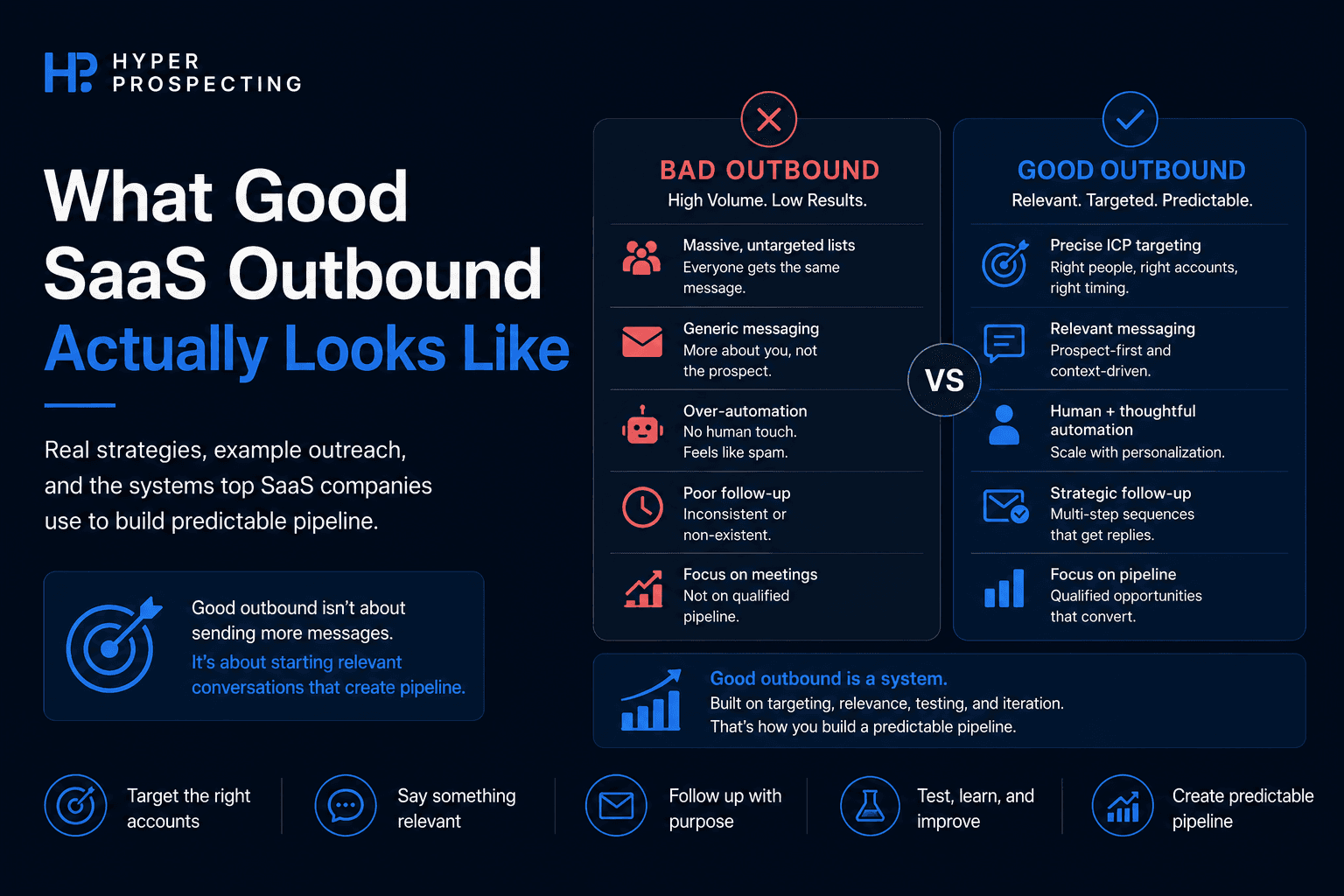
What Good SaaS Outbound Looks Like: Key Points
Precise targeting matters more than volume
Messaging needs to feel relevant to the specific person receiving it
Good outbound is focused on pipeline quality, not just meeting numbers
Strong outbound campaigns are built on testing and iteration, not just automation
The best results come from combining clear strategy, good timing, and careful execution
The Biggest Misunderstanding About SaaS Outbound
Most teams think outbound is a copywriting problem. If they could just get the subject line right, or find the perfect opening line, the replies would start coming in. So they tweak the email. Change the CTA. Try a different format. And the results stay roughly the same.
The issue is not the copy. The issue is that they are treating outbound as a messaging exercise rather than a system.
Outbound is not just sending emails. It is building a process that consistently gets the right message in front of the right person at the right moment — and then doing something useful with what comes back. That involves targeting, timing, sequencing, qualification, and continuous testing. Copywriting is one small part of a much larger set of decisions.
Tooling makes this worse. There are more sequencing platforms, AI writing tools, and data providers available now than ever before. Teams buy the tools, set up the automations, and launch. But if the targeting is vague and the messaging is generic, better tools just produce more of the same. They accelerate the output without improving the quality of what is being sent.
Automation without relevance is not outbound. It is spam with good deliverability.
What Bad SaaS Outbound Usually Looks Like
Bad outbound is everywhere. Most people reading this will have received examples of it in their own inbox this week. It tends to share the same characteristics.
Massive prospect lists. The assumption is that a bigger list means more replies. It does not. It means more emails going to people who have no reason to care, which drives down reply rates and damages deliverability over time.
Generic messaging. The email could have been sent by any company, to anyone. It opens with the sender’s company name, lists some features, and asks for a call. Nothing in it gives the recipient a reason to think it was written for them specifically.
Over-automation. Every touchpoint is automated. Follow-ups go out on a fixed schedule regardless of what has happened in the conversation. There is no judgement applied to when to stop, when to change the message, or when someone is genuinely interested versus just curious.
Poor ICP targeting. The list was built by filtering for a job title and a company size. That is a starting point, not a targeting strategy. Without understanding which companies are likely to have the problem you solve right now, the outreach is essentially a guess.
Meetings as the goal. The whole programme is measured by meetings booked. But meetings with the wrong people are not a success. They are a cost — in time, in energy, and in the attention of your sales team.
What Good SaaS Outbound Actually Looks Like
Good outbound is harder to describe because it is less about a specific tactic and more about how a set of decisions are made and how they fit together. Understory’s guide to B2B outbound marketing strategies captures this well, the teams producing consistent pipeline are the ones who treat outbound as a coordinated system rather than a series of separate activities. But there are consistent elements.
A clear ICP definition
Not just a job title and a company size. A genuine understanding of which companies are most likely to have the problem your product solves, what their situation tends to look like, and why they are in a position to act on it. This takes work. It usually means talking to your best existing customers and understanding what was true for them when they first needed what you offer.
Account segmentation
Not all accounts in your ICP are equally worth pursuing right now. Good outbound segments the list by how likely different groups are to be actively dealing with the problem. Companies that have recently hired in a specific function, raised funding, or changed a key piece of their tech stack are often better targets than companies that simply fit the firmographic profile.
Buying signal identification
Trigger events matter. A new VP of Sales joining a company is a signal. A product launch, a job posting for a particular role, or a funding announcement — all of these can indicate that a company is in a place where your offer is more likely to be relevant. Good outbound teams look for these signals and use them to time outreach better.
Relevant messaging
The message references something specific. It is not about your features. It is about a problem the recipient is likely dealing with, described in terms they would actually use. It is short. It makes one clear ask. And it does not try to close a deal in the first email.
A proper follow-up structure
Follow-ups add something. A different angle, a piece of relevant context, a short question that tests intent. They are not just the same message resent with “following up on my last email” at the top. Callbox’s research on outbound sequencing shows that a multichannel approach with structured touchpoints improves conversion rates significantly compared to single-channel outreach — but only when each touchpoint is adding something rather than just repeating the last one.
Deliverability setup
Domains are warmed up properly. Sending volumes are sensible. The technical foundation is in place so the emails actually reach the inbox. This is table stakes, but a surprising number of teams skip it.
Testing and iteration
The campaign is treated as something to learn from, not just something to run. Message variants are tested. Segments are compared. What is working gets more resource. What is not gets changed or cut.
Bad Outreach vs Better Outreach: A Simple Comparison
The difference between poor and effective outbound messaging is easier to understand with an example. This is not about producing a perfect template. It is about showing why relevance beats cleverness every time.
A typical bad example
Subject: Quick question
Hi [First Name],
I’m reaching out because we help SaaS companies generate more leads through our outbound platform. We’ve worked with over 200 companies and helped them book more meetings with less effort.
Would you be open to a 15-minute call to see if we might be a fit?
Best,
[Name]
What is wrong with this? It opens with the sender’s company. It describes a solution before establishing a problem. It could have been sent to anyone. There is nothing in it that makes the recipient feel like the email was written for them. The ask — a 15-minute call to “see if we might be a fit” — gives the recipient no real reason to say yes.
A better version
Subject: SDR headcount at [Company]
Hi [First Name],
Noticed you’ve been hiring SDRs this quarter — usually a sign there’s pressure to build pipeline faster than the team can manage it manually.
We help SaaS sales teams at your stage build structured outbound systems so they can generate qualified conversations without needing to double headcount.
Worth a quick conversation to see if the timing is right?
[Name]
This email opens with something specific the recipient can verify. It names a problem they are likely experiencing rather than a solution they do not yet know they need. The ask is lighter and easier to say yes to. It does not try to do too much.
The difference is not the writing. It is the thinking behind it. The second email required knowing something specific about the company before sending. That is what makes it relevant. And relevance is what gets replies.
Why Targeting Matters More Than Copy
Most outbound advice focuses on messaging. How to write a better subject line. How to personalise at scale. How to structure a follow-up sequence. This advice is not wrong. But it treats a secondary problem as if it were the primary one.
Targeting is the primary problem. A well-written email sent to the wrong person will still be ignored. An average email sent to someone who is actively dealing with the problem you solve has a real chance of getting a reply. Autobound’s analysis of outbound benchmarks across 100+ SaaS teams found that smaller, tightly targeted campaigns of 50 or fewer recipients produce a 5.8% response rate — compared to the far lower rates typical of bulk sends to generic lists. The list is where most of the work needs to happen.
Many SaaS teams obsess over subject line open rates while their list is full of people who have no reason to engage with their offer. The subject line is not the issue. The list is.
Timing matters too, and it is underrated. The same prospect at two different points in time will respond very differently to the same outreach. Reaching someone the week they have taken on a new role, or the month their company just raised a round, puts you in a different conversation to reaching them at a random moment. This is why trigger-based targeting produces better results than static list-based outreach.
Context does the work that copy cannot. When a prospect receives a message that clearly references their situation, their timing, or a problem they are actively dealing with, the message does not need to be clever. It just needs to be clear.
Why Most SaaS Companies Scale Too Early
There is a common pattern in how SaaS teams approach outbound. They decide to invest in it, set up the tooling, build a list, write some emails, and launch at volume. When results are disappointing, they increase the send volume, add more channels, or hire another SDR. The problem gets bigger without getting better.
This happens because they scaled before validating.
Scaling a broken system produces more broken results, faster. If the ICP is not right, sending to ten times the list gives you ten times the wrong contacts. If the messaging is not landing, automating the follow-up sequence means ten times the ignored messages going out.
The smarter approach is to treat the early stage as a validation exercise. Run a small, tightly targeted campaign with enough volume to generate signal. Look at who replies and what they say. Look at which segments engage and which do not. Look at which messages produce interest and which get ignored. Jordan Digital Marketing’s analysis of B2B SaaS outbound in 2025 makes a similar point well: SDRs should be brought in to amplify what is already working, not as a first step before the messaging and targeting have been figured out.
That data tells you what to build. Running a campaign without this phase is just paying to learn the wrong lessons slowly.
What a Strong SaaS Outbound System Includes
When outbound is working, it tends to follow a clear progression. The teams that produce consistent pipeline are almost always the ones who built their programme in phases rather than launching everything at once.
Phase 1: Validate
Before building infrastructure or investing in volume, the priority is testing assumptions. Which segments respond? Which messages land? Which trigger events produce the most relevant conversations? This phase should be small enough to move quickly and specific enough to produce real learning. Run it with a focused list, a small number of message variants, and honest criteria for what counts as a positive signal.
Phase 2: Build
Once there is signal, build the system to support it. Set up sequencing properly. Establish the qualification criteria for what a good reply looks like. Create a reporting process that tracks the right metrics — positive reply rate, qualified conversations, and pipeline progression — rather than just open rates and send volume. Document what is working so it can be repeated and improved.
Phase 3: Scale
With a validated approach and a built system, scaling produces proportional results. Expand into adjacent segments. Add channels where they make sense. Increase volume where the targeting is confirmed to work. At this stage, adding resource produces more of what is already working, rather than more of what is not.
Most teams do this in reverse. They scale first, then try to build a system around the results, then eventually realise the underlying approach has not been validated. Starting with Phase 1 is slower in the short term and significantly faster in the long term.
The Real Goal of SaaS Outbound
It is worth being direct about what the goal of outbound actually is, because it gets confused more often than it should.
The goal is not replies. A high reply rate from unqualified prospects is not a success. It is a sign that the targeting is too broad and the messaging is too vague.
The goal is not meetings. A calendar full of calls with people who do not fit your ICP is not pipeline. It is wasted time for your sales team and a cost that will show up in your conversion rates.
The goal is qualified pipeline. Real opportunities with people who have the problem, the budget, the authority, and a reason to act within a realistic timeframe. That is what outbound is supposed to produce. Everything else is in service of it. Belkins’ pipeline generation guide covers what this looks like in practice, the mechanics of turning outbound activity into actual pipeline, and where most programmes lose the thread between the two.
When you define success that way, it changes how you build the system. You stop measuring send volume and start measuring qualified conversation rate. You stop chasing meeting targets and start thinking about what percentage of your meetings are turning into genuine opportunities. You stop asking “how do we get more replies?” and start asking “how do we get more of the right replies?
That is the shift that separates outbound that produces pipeline from outbound that just produces activity.
Conclusion
Good SaaS outbound is not built on volume. It is not built on automation. And it is not built on finding the perfect subject line formula.
It is built on knowing exactly who you are trying to reach and why, writing messages that speak directly to their situation, testing your assumptions before scaling them, and measuring the outcomes that actually matter.
When those things are in place, outbound stops being a frustrating expense and starts being a predictable source of pipeline. That is not a difficult concept. But it takes more work than most teams are willing to do before they hit send.
Further Reading
If your outbound campaigns are not producing the results you expected, these posts cover the specific issues in more detail:
Why Cold Emails Often Get No Replies (And What Actually Gets Responses)
How to Build a B2B Outbound System That Actually Generates Pipeline
How to Choose a SaaS Lead Generation Agency (Without Getting Burned)
Best B2B Lead Generation Agencies For SaaS (2026) - And Which Ones Actually Work
FAQ
What is SaaS outbound lead generation?
SaaS outbound lead generation means proactively reaching out to potential buyers through channels like cold email and LinkedIn, rather than waiting for them to find you. When it is done well, it creates a predictable flow of qualified conversations. When it is done badly — with poor targeting and generic messaging — it produces low reply rates and wasted budget.
Why do most SaaS outbound campaigns fail?
The most common reasons are poor targeting, generic messaging, and a lack of structured testing. Most campaigns are treated as a volume exercise — the assumption being that more emails means more replies. But without relevance, volume just produces more of the same result. Campaigns also fail because they scale before the core approach has been validated, which means the problems get bigger rather than getting solved.
Is outbound still effective for SaaS in 2026?
Yes, but the bar has risen. Generic, automated outreach produces diminishing returns. Outbound that is built on precise targeting, relevant messaging, and a clear understanding of buyer timing continues to generate pipeline consistently. The difference between what works and what does not is wider than it used to be.
What is the difference between good and bad outbound?
Good outbound starts with a clear picture of who the right prospect is, why they might be ready to engage right now, and what problem the message needs to speak to. It is tested, iterated, and measured against pipeline quality rather than activity. Bad outbound starts with a big list and a template, assumes volume will compensate for lack of relevance, and measures success by meetings booked regardless of whether those meetings go anywhere.
About the Author
Written by Leigh Hankin, Founder of HyperProspecting
Specialising in outbound lead generation systems for B2B companies.